
Search This Blog

Wednesday, 5 October 2022

Users’ experiences in a regional university library makerspace

This is a summary of Emilia Bell's presentation at the LARK 2022 Symposium
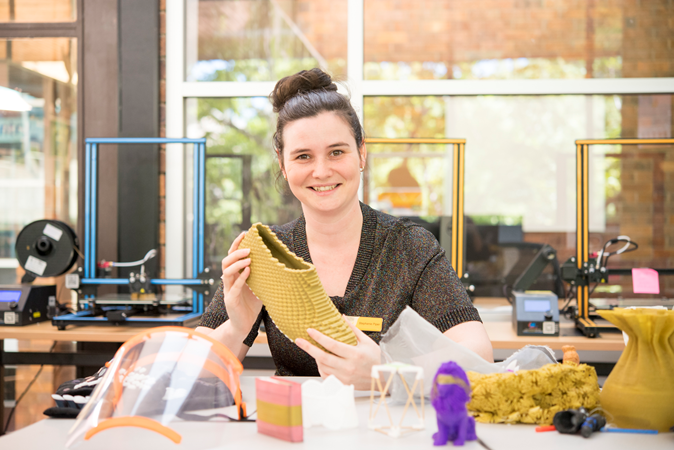

The UniSQ Makerspace is a community space used for creating and hands-on activities. It includes equipment for digital fabrication, electronics, and crafting (UniSQ Library Makerspace, n.d.). Responding to a gap in the literature on “makerspaces within Australian universities,” the University of Southern Queensland (UniSQ) Library’s Coordinator (Evidence Based Practice) and Coordinator (Community Engagement) undertook a practice-based research project, seeking local evidence to inform the UniSQ Library Makerspace (Wong & Partridge, 2016, p. 146).

Part of UniSQ Library’s commitment to evidence-based practice includes going beyond the analysis and interpretation of evidence to applying findings and communicating these. This means integrating evidence into our practice, improving the delivery of library services, and contributing to the wider LIS evidence base. Clare Thorpe (2021a, 2021b) has described the benefits of sharing work across a range of forums, reaching different audiences. While applying the findings from this case study may not be a linear process, the evidence collected helps to highlight the Makerspace’s value to its users, address barriers to participation, and support its increased visibility.

We designed a case study to explore, first, how UniSQ Makerspace users were engaging with the space and its activities, and second, what users own experience of participation could tell us about the Makerspace’s value for research, course curriculum, and extra-curricular benefit. 

The findings presented the different stages and types of value experienced by users as they described the processes and time taken to explore what was on offer in the Makerspace, and the impact it had for them.

The case study design incorporated a visual method in the data collection phase and findings were developed through a reflective thematic analysis. The visual method was a variation of a photovoice technique. Including a visual element aligned with the very nature of the Makerspace itself, as the projects and technology in the Makerspace are very tactile, hands-on, and involve visual outputs. It provided a unique way for participants to share work that was meaningful to them and how they engaged in the space.

By having the choice to share projects, or to just describe them verbally, participants could choose when they wanted to centre their own projects in the conversation, and they could determine how much significance the physical object (or a visual representation of it) held to describing their own experiences.

Five themes were developed from the interview transcripts:
1. A Tentative Start
2. Practical Motivations
3. Skills Development
4. Community Connection
5. Influencing Outlook

We found that, while interview participants experienced initial curiosity around the
Makerspace, this was alongside hesitancy and a lack of understanding of its purpose. For some students this presented as a feeling of “not being able to in there without … thinking that I'm intruding” (CC1). Without an understanding of purpose, there was uncertainty around who belonged and could utilise the space.

Formal introductions to the Makerspace, embedded in coursework, helped to highlight its practical and functional value, for both study and research. It was, then, after becoming involved, that the opportunities for skills development and community connection were realised.

Ongoing participation saw participants develop new perspectives, knowledge, and future pathways. These new outlooks grew from an understanding of how creativity, technology, and science could come together to help others. As one student described:
“I didn't expect this to now be such a big part of my life … nearly every day I'm thinking about what I can print, what I can design … how I can make something better … it's made a huge difference, and I didn't think it would” (CC2).
Together, these five themes reflected a narrative of users’ engagement with the Makerspace that developed from a tentative curiosity to finding value in new perspectives, skills, and a creative community to participate in.

References
Thorpe, C. (2021a). Announcing and advocating: The missing step in the EBLIP model. Evidence Based Library and Information Practice, 16(4), 118–125. https://doi.org/10.18438/eblip30044
Thorpe, C. (2021b). Sharing and communicating – a necessary addition LIS evidence based practice model. https://lark-kollektive.blogspot.com/2021/12/sharing-and-communicating-necessary.html
UniSQ Library Makerspace. (n.d.). About. https://makerresources.usq.edu.au/index.php/314-2/
Wong, A., & Partridge, H. (2016). Making as learning: Makerspaces in universities. Australian Academic & Research Libraries, 47(3), 143-159. 
 https://doi.org/10.1080/00048623.2016.1228163


Emilia Bell is the Coordinator (Evidence Based Practice) at the University of Southern Queensland. They are also a PhD student at Curtin University, member of the ALIA New Generation Advisory Committee, and have worked in academic and school libraries.
Emilia.Bell@outlook.com @EmiliaCaraBell

Tuesday, 4 October 2022

LARK 2022 Symposium in tweet and picture

The LARK 2022 Symposium was last week, just as inspiring as we expected. Many people travelled from other states and New Zealand to participate in a great day of discussions about library and information research in practice. After the formal part of the day, we continued with post-symposium drinks to celebrate LARK's tenth anniversary. For all our colleagues who wish to know how the day unfolded, we'd like to share this Twitter feed and some pictures. Hope to see you next time.

#LARK2022 on Twitter


Raising a glass to LARK


Monday, 19 September 2022

Are we a profession? Doctors Cameron M. Pierson & Elizabeth Tait answer

The question of ‘are we a profession?’ is something of a fixture for LIS. As an ‘interstitial’ profession (yes, profession), we see why this is a reoccurring topic (e.g., Raju, 2020). When our disciplinary boundaries span multiple domain areas, whilst also including those specific to our jurisdiction, we naturally ask ourselves questions related to identity and societal function.
Something we find interesting is the notion that the defining feature of ‘profession’ is its research activity (Howard, 2022). As members of the research and education-oriented side of the profession, we certainly agree that research is important. As was pointed out, however, there are other aspects which contribute to the composition and designation of a profession, such as ethics and engaging with disciplinary knowledge, of which a body of knowledge develop through research is but one form (Bell, 2022). We would suggest also for LIS, and the larger GLAMR sector, another key aspect naturally includes our societal function: co-constructed service to community rooted in information and cultural heritage.
We certainly agree that a part of what constitutes a profession is its willingness to seize opportunities to engage with new knowledge. Being a profession characterized by information and curiosity, we are undoubtedly in no shortage of such opportunities in the modern world. As our societies and world grow increasingly socio-technical, we have the dual task of remaining socially focused while being technologically adept. This task will only grow in importance, as we can offer a unique contribution to technological innovation, development, and its social navigation.
For example, we recently identified several professional opportunities in relation to artificial intelligence – for research, practice, and the meeting of the two (Tait & Pierson, 2022). We found ample opportunity to include more professional education around AI, as a technology that will very likely impact societal information interaction and information services. We similarly argue professional contribution can take the form of strengthened voices in information ethics grounded in LIS expertise. Of course, along with increased research and educational space, we also suggest Communities of Practice, and inter-institutional collaborative networks, such as for the development of open educational resources on AI and information ethics in LIS and the GLAMR sector.
The topics we discuss draw on the various aspects used to define ‘profession’, highlighting their interlocking nature. If a profession is characterised, amongst other things, by its research activity, it is also characterised by the opportunities it takes – in both research and practice, benefiting from a symbiotic relationship. Moreover, LIS occupies both unique and other disciplinary grounds, suggesting further benefit in the production of our forms of knowledge, both theoretical and practical. Perhaps this prompts us to consider our interstitial nature as being our strength, a defining feature of our profession’s adaptability.

References Bell, E. (2022, September 1). Are we a profession? Emilia Bell answers. ALIA LARK. https://lark-kollektive.blogspot.com/2022/09/are-we-profession-emilia-bell-answers.html
Howard, K. (2022, August 28). Are we a profession? ALIA LARK. https://lark-kollektive.blogspot.com/2022/08/are-we-are-profession.html
Raju, J. (2020). Future LIS Education and Evolving Global Competency Requirements for the Digital Information Environment: An Epistemological Overview. Journal of Education for Library and Information Science, 61(3), 342+. https://doi.org/10.3138/jelis.61.3.2019-0088
Tait, E. & Pierson, C. M. (2022) Artificial Intelligence and Robots in Libraries: Opportunities in LIS curriculum for preparing the librarians of tomorrow. Journal of the Australian Library and Information Association, 71(3), 256-274. https://doi.org/10.1080/24750158.2022.2081111

Dr Cameron M. Pierson is a Senior Researcher and Project Manager at L3S Research Center in Hannover, Germany and a Research Fellow at Victoria University of Wellington, New Zealand.
Dr Elizabeth Tait is a Senior Lecturer in Information Studies at Charles Sturt University where she is a Course Director.

Tuesday, 6 September 2022

Revisiting Relevance 2020 – What Next for LIS Research in Australia?

By Professor Lisa M. Given

More than five years ago, the Australian Library and Information Association (ALIA) published a report documenting outcomes of a series of research meetings held in 2016. Working in partnership with Charles Sturt University (where I was Professor at the time), ALIA’s Relevance 2020 series set out to explore the state of library and information science (LIS) research across the country. Many universities served as hosts for the events, which attracted 172 participants from across the sector.

The report found:

• Seven barriers to research and collaboration (between LIS researchers and practitioners): awareness and perception; connection and relationship; funding; passion and enthusiasm; research culture and support; research expertise; shared understanding and interest

• 37 enablers for research and collaboration, including: funding; time; mentoring; research training; institutional support

And the report included four recommendations:

• Libraries and librarians should change the perception of their roles to include research as part of their role specification. This would be a powerful catalyst for a more dynamic, evidence-based profession.

• LIS schools and academics should be active players in fostering collaboration between academia and practice. Applied research should not be regarded as less important than research of a more theoretical nature.

• More consideration might be given by LIS academics to some of the priority areas for their practitioner counterparts, such as information services and the promotion of these services.

• ALIA should continue to play a role that bridges the gap between academic and practitioner needs. Consideration should be given to a central database of research ideas and experts, and to strategically providing further funding opportunities to members.

At the time, Professor Helen Partridge and I had just embarked on our “LISRA” Project – an Australian Research Council Linkage Project (Assessing Library and Information Studies Research Networks), in partnership with ALIA and National and State Libraries Australasia (NSLA). The project was designed to encourage and enable research culture and practice within the LIS profession in Australia. As part of LISRA, we launched the Research Assistance and Development for Australian Researchers (RADAR) program. RADAR provided small-scale funding to support collaborative teams of LIS researchers and practitioners to come together for a 12-month period to design and implement a study to provide an evidence-base for potential change within the sector. 

Little did Helen and I know when we first designed, applied for, and received the ARC Linkage funding that so many of our proposed activities would echo and resonate with the issues discussed at Relevance 2020. We have learned so much about the library and information research landscape in Australia, including the supports and enablers that can help collaborative teams to succeed.

Do you want to learn more about the RADAR project and what we learned through this important work? I will be sharing some of the lessons learned at the LARK Symposium 2022 in Sydney later this month. Details on the event and the link to register can be found at https://lark-kollektive.blogspot.com/p/lark-symposium-2022.html. I hope to see you there!

References:

Nguyen, L. 2017. Relevance 2020: LIS Research in Australia. ALIA: Canberra. Available at: https://read.alia.org.au/sites/default/files/documents/alia-relevance-2020-lis-research-in-australia-online.pdf 


Professor Lisa M. Given
Director, Social Change Enabling Capability Platform & Professor of Information Sciences
RMIT University
lisa.given2@rmit.edu.au
Twitter: @lisagiven
http://lisagiven.com/ 


Thursday, 1 September 2022

Are we a profession? Emilia Bell answers

Are we a profession? 

The first answer comes from Emilia Bell, Coordinator (Evidence Based Practice) at the University of Southern Queensland

Is it fitting that we currently call Library and Information Science (LIS) in Australia a profession? Yes, but doing so means engaging with new knowledge which does require sustaining research in future practice.

In understanding ‘professions’ to be grounded in ethical standards and specialised knowledge, research remains a valuable and necessary contribution to the LIS professions' knowledge base and practice. Our professional expertise and judgments should build on professional ethics and knowledge, with knowledge being acquired, created, and applied through various processes, research being one.

perhaps engagement with new knowledge should guide our understanding of whether we have a profession

Juznic and Urbanija (2003) recognise that “research is needed to create new knowledge”. Undertaking research is vital in contributing to our professional knowledge base, and should be “published, shared, questioned, and debated” (Howard, 2022). For this, perhaps engagement with new knowledge should guide our understanding of whether we have a profession. This still presents an imperative to engage with research processes for knowledge creation, but also captures coinciding methods of inquiry and knowing (McGregor, 2021) that may inspire future research directions as a profession and a discipline.

Many overlapping processes (including research, evidence-based practice, and reflection) allow us to engage with our professional ethics and values, taking them beyond aspirational to being realised in practice (Young, 2020). Positioning ‘knowledge’ as a basis for the profession highlights other processes of inquiry, such as critical reflection, that help support the application of knowledge and ethics to practice. This requires we are deriving new knowledge from research while acknowledging those other processes that I hope will facilitate curiosity and interest in 'doing research' and going beyond routine as a profession.

References
Howard, K. (2022, August 28). Are we a profession? ALIA LARK. https://lark-kollektive.blogspot.com/2022/08/are-we-are-profession.html

Juznic, P., & Urbanija, J. (2003). Developing research skills in library and information science studies. Library Management, 24(6/7), 324-331. https://doi.org/10.1108/01435120310486048

McGregor, R. (2021, November 6). Reflective practice. Is this the library?. https://rowenamcgregor.com/2021/11/06/reflective-practice/

Young, S. W. H. (2020). On ethical assessment: Locating and applying the core values of Library and Information Science. Library Assessment Conference. https://www.libraryassessment.org/wp-content/uploads/2021/06/87-Young-On-Ethical-Assessment.pdf

Monday, 29 August 2022

LARK 2022 Symposium grants

LARK wishes to encourage attendance by library and information students, and colleagues outside Sydney. We offer two grants to cover the registration cost and contribute to traveling expenses. 

Applications are invited for 

  1. registration grant or
  2. traveling grant to a person who lives outside Sydney. It includes $300 support for expenses and free registration.

The priority will be given to: 

  • Professionals from rural and remote areas
  • Full-time library and information students
  • Indigenous library and information workers and students

Applicants need to

  • indicate for which grant they are applying
  • include proof of regional or remote address and/or current full-time student status
  • letter of recommendation: 
    • STUDENTS - from an academic staff who taught the applicant during their current course of library and information studies
    • EMPLOYED APPLICANTS - from the current supervisor
    • INDEPENDENT PROFESSIONALS - from an academic staff or former work supervisor.

Please send applications to lark.kollektive(at)gmail.com by Friday, 9 September 2022 COB.

Successful candidates will be informed by Monday, 12 September.

Sunday, 28 August 2022

Are we a profession?

Dr Katherine Howard

I recently had the privilege of working on the ARC funded Library and Information Science Research in Australia (LISRA) project. When preparing a literature review for on aspect of the project, I came across a quote that I have not been able to get out of my head (emphasis added):
Library and information science (LIS) has emerged, not only as a profession and the educational programme that supports it, but also as a research discipline. Research is needed to create new knowledge and thereby contribute to the growth of LIS as a profession or discipline. If research is absent, non-existent or even scarce, there is no profession, but only an occupation grounded in techniques, routine and common sense (Juznic and Urbanija, 2003).

Further, if we consider that the Australian Council of Professions defines (in part) a
profession as:
a disciplined group of individuals who [...] are accepted by the public as possessing special knowledge and skills in a widely recognised body of learning derived from research, education and training at a high level [...] (2003, emphasis added) ...

... do we really have a profession?

From my experience, and what I have observed, my answer would have to be ‘no.’ Now please don’t think I am ‘dissing’ my own sector – quite the opposite. If I didn’t love this sector and care about its future, I would just stay quiet. But I do care. I care that there seems to be very little research undertaken, published, shared, questioned, and debated.

Perhaps more worrying is that there seems to be very little interest in even finding out what it means to do research – proper, actual, rigorous research. I understand the constraints: there’s no time, there’s no support, there’s no recognition – all factors that have been written about in the literature and largely supported by findings from the LISRA project. But if we think we are already “doing research” and therefore we are “a profession” and nothing needs to change ... I beg to differ.

“Research” – sometimes incorrectly referred to as “academic research” - is a
methodologically sound investigation into a ‘thing.’ Ironically, the people who understand what I am talking about in the previous sentence are those who have undertaken research themselves. On reflection, perhaps it is not so ironic – it the difference between sympathy and empathy. You can’t empathise with something you have never empirically experienced, no matter how much you know about the topic or situation. 

So – I’d love to know what other people think. Within the bounds of the two quotes above, are we a profession? Why/why not?

Send us your responses and we will share them on this blog and Twitter.


References
Australian Council of Professions (2003). What is a Profession?

Juznic, P., & Urbanija, J. (2003). Developing research skills in library and information science studies. Library Management, 24(6/7), pp. 324-331. 

Dr Katherine Howard, eResearch Analyst, Intersect