
This is a summary of Emilia Bell's presentation at the LARK 2022 Symposium
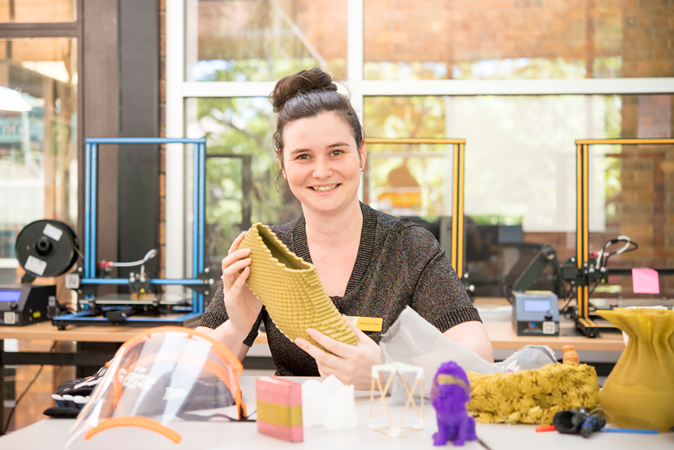
The UniSQ Makerspace is a community space used for creating and hands-on activities. It includes equipment for digital fabrication, electronics, and crafting (UniSQ Library Makerspace, n.d.). Responding to a gap in the literature on “makerspaces within Australian universities,” the University of Southern Queensland (UniSQ) Library’s Coordinator (Evidence Based Practice) and Coordinator (Community Engagement) undertook a practice-based research project, seeking local evidence to inform the UniSQ Library Makerspace (Wong & Partridge, 2016, p. 146).
Part of UniSQ Library’s commitment to evidence-based practice includes going beyond the analysis and interpretation of evidence to applying findings and communicating these. This means integrating evidence into our practice, improving the delivery of library services, and contributing to the wider LIS evidence base. Clare Thorpe (2021a, 2021b) has described the benefits of sharing work across a range of forums, reaching different audiences. While applying the findings from this case study may not be a linear process, the evidence collected helps to highlight the Makerspace’s value to its users, address barriers to participation, and support its increased visibility.
 We designed a case study to explore, first, how UniSQ Makerspace users were engaging with the space and its activities, and second, what users own experience of participation could tell us about the Makerspace’s value for research, course curriculum, and extra-curricular benefit.
 The findings presented the different stages and types of value experienced by users as they described the processes and time taken to explore what was on offer in the Makerspace, and the impact it had for them.
The case study design incorporated a visual method in the data collection phase and findings were developed through a reflective thematic analysis. The visual method was a variation of a photovoice technique. Including a visual element aligned with the very nature of the Makerspace itself, as the projects and technology in the Makerspace are very tactile, hands-on, and involve visual outputs. It provided a unique way for participants to share work that was meaningful to them and how they engaged in the space.
By having the choice to share projects, or to just describe them verbally, participants could choose when they wanted to centre their own projects in the conversation, and they could determine how much significance the physical object (or a visual representation of it) held to describing their own experiences.
Five themes were developed from the interview transcripts:
1. A Tentative Start
2. Practical Motivations
3. Skills Development
4. Community Connection
5. Influencing Outlook
We found that, while interview participants experienced initial curiosity around the
Makerspace, this was alongside hesitancy and a lack of understanding of its purpose. For some students this presented as a feeling of “not being able to in there without … thinking that I'm intruding” (CC1). Without an understanding of purpose, there was uncertainty around who belonged and could utilise the space.
Makerspace, this was alongside hesitancy and a lack of understanding of its purpose. For some students this presented as a feeling of “not being able to in there without … thinking that I'm intruding” (CC1). Without an understanding of purpose, there was uncertainty around who belonged and could utilise the space.
Formal introductions to the Makerspace, embedded in coursework, helped to highlight its practical and functional value, for both study and research. It was, then, after becoming involved, that the opportunities for skills development and community connection were realised.
Ongoing participation saw participants develop new perspectives, knowledge, and future pathways. These new outlooks grew from an understanding of how creativity, technology, and science could come together to help others. As one student described:
“I didn't expect this to now be such a big part of my life … nearly every day I'm thinking about what I can print, what I can design … how I can make something better … it's made a huge difference, and I didn't think it would” (CC2).
Together, these five themes reflected a narrative of users’ engagement with the Makerspace that developed from a tentative curiosity to finding value in new perspectives, skills, and a creative community to participate in.
References
Thorpe, C. (2021a). Announcing and advocating: The missing step in the EBLIP model. Evidence Based Library and Information Practice, 16(4), 118–125. https://doi.org/10.18438/eblip30044
Thorpe, C. (2021b). Sharing and communicating – a necessary addition LIS evidence based practice model. https://lark-kollektive.blogspot.com/2021/12/sharing-and-communicating-necessary.html
UniSQ Library Makerspace. (n.d.). About. https://makerresources.usq.edu.au/index.php/314-2/
Wong, A., & Partridge, H. (2016). Making as learning: Makerspaces in universities. Australian Academic & Research Libraries, 47(3), 143-159. https://doi.org/10.1080/00048623.2016.1228163

Emilia Bell is the Coordinator (Evidence Based Practice) at the University of Southern Queensland. They are also a PhD student at Curtin University, member of the ALIA New Generation Advisory Committee, and have worked in academic and school libraries.
Emilia.Bell@outlook.com @EmiliaCaraBell


.png)


