After more than ten years, LARK is leaving this blog. It served us well and saw us grow. Thank you for visiting this site and reading our posts. All the content has been transferred to our new pages. You can find us at
Search This Blog
Thursday, 1 June 2023
Monday, 15 May 2023
LARK Circles Launch & Reflective Practice Webinar
REGISTER by 28 May
Tuesday, 27 December 2022
At the end of LARK’s anniversary year: Three insights for the future
At the LARK 2022 symposium, I overviewed 10 years of LARK (see slides). Since its inception in late 2012, we have organised meetings and workshops in Sydney, Brisbane, Adelaide, and Perth; webinars; and three whole-day symposia in Sydney and online. Nearly all the events were organised and facilitated by a group of volunteers situated in Sydney, although we’ve recently had webinars run from other states. LARK also led the first Antipodean LIS reading group on Twitter in 2015/16 with three facilitators from across Australia. Our presenters and audience, however, have always been national and international.
LARK’s blog has visitors from around the world, the majority from the United States. The last time I counted, the blog had over 240 000 visits, and posts had around 1600 views on average. A closer look at the statistics suggests that a good proportion are genuine views.
In the ten years of its existence, LARK has raised awareness about practice-based research in LIS, and developed a community of practice. Capacity building, advocacy, promotion, and advice provided to professional organisations have all been a regular part of our work. As a grassroots group, we have been in a unique position to foster connections across sectors, profession and academia, as well as with colleagues in other countries.
- Research as everyone’s business
- Head-heart-hands as a paradigm, and
- From grassroots to landscape.
Research as everyone’s business
Many others, however, are just not interested. They don’t come even when it is most convenient — there is never enough time or energy. For a long time, I thought it might be because we are a small field, and practice-based research isn’t established enough. I admired health professionals and research cultures in their applied disciplines because they have an appreciation of research, and a sense of urgency to use solid evidence unparalleled in other fields. Possibly, uneven enthusiasm in LIS makes sense because of the nature of our work. After all, no one dies because the librarian isn’t interested in research.
However, as it happened, I landed a job in health education research, established a peer-reviewed journal, and worked with health practitioners on publishing their research findings. Repeatedly, I heard research stories and opinions so similar to those I knew from LIS and secondary education until it became apparent that some issues are part and parcel of practice-based research, whatever the field. Research requires a particular mindset — primarily curiosity — and an ability to deal with risk and uncertainty in all disciplines. Some excellent professionals like learning and being up-to-date, but have no desire to be researchers. Research just isn’t for everyone.
Health, however, is a much bigger and better funded field than ours. Evidence-based practice (EBP) and research are placed on a continuum with many degrees. Discussions about the finer points of EBP, evaluation, research, and translational research in health helped in teasing out some meanings and problems in professional practice in general. Caveats aside, an important point of difference between health and LIS emerged from my time in health education research. In health, it is every professional’s job to know about the current evidence. Research matters and it is everyone’s business.
Our profession is yet to develop the same foundational understanding. It isn’t that we don’t know that the original research has value, but the way we question it shows that it isn’t an integral part of our professional thinking. LIS professionals and academics, LARK included, need to continue conversations with professional associations and organisations to raise the research bar for our profession. Research will be done only by some, but it needs to be everyone’s business.
Head-heart-hands paradigm
Learning is powerful when students engage their heads, hearts, and hands. A student needs to understand something with their head, connect it with their heart and do something with their hands. This is an Ignatian pedagogical paradigm, followed by many independent schools in Australia. (See this article as an example of its application. The paradigm is used here as a pedagogical approach regardless of its origins in religion.)
The head-heart-hands approach sounds true for research in practice, which really is another form of learning. We use theoretical knowledge and research skills in our head to apply in our practice — our doing hands. Hands, in turn, inform and guide the head. In between, the heart mediates: an expert's intuition connects the thinking head and doing hands. This is where our passion to serve our clients resides as well. Practitioners often see research problems differently from academics because they work with head-heart-hands synergy. It is important to understand this point of difference between academic and practice-based research without turning it into a value statement, so that LIS research can benefit from practitioners’ unique research position.
This paradigm could be also applied to some broader changes for LIS in Australia, with parallels in other parts of the world. Many library roles are now performed by professionals from other fields. In recent years, most university LIS departments have ceased to exist, and former academics are becoming practitioners. These trends are positive when they expand the range of skills and experiences; other trends, such as the closures of university departments, are devastating for our field. Whatever their meaning, these trends have a potential to strengthen the head-heart-hands paradigm. Former academics are becoming important research resources in organisations, and a new range of skills may become an important asset in our professional hands. What are possible alliances between people with different backgrounds and skills? Are we opening new conversations to connect the head, heart, and hands that will lead to new lines of research in practice? It is possible and advisable to harness these trends as an opportunity to improve our research and practice.
LARK already gathers academics and practitioners from different sectors, and we would welcome new people in the library and information practice. We speak languages of different professional groups and could help with the transition, possibly turning some negative trends to our advantage as a field.
From grassroots to landscape
As a grassroots group, LARK has done an important job developing a community of practice, and raising awareness about the importance of LIS research in practice. ALIA’s administrative help was valuable, and we appreciated the support of our employers and other libraries giving us digital and physical spaces for our events. All the work, however, was done by a small group of volunteers who devoted their time and energy to LARK on top of their full-time jobs and busy lives, with no special funding. At the end of our symposium in September, we discussed LARK’s future and agreed it was time for LARK and Australian LIS research in practice to obtain some reliable funding and develop stronger structural support.
In 2015, when professors Helen Partridge and Lisa Given announced their LISRA project grant at the EBLIP8 conference, I wrote a post about inspiring insights from the conference. It was time to establish purposeful connections between grassroots groups and supporting structures — it was time to develop landscapes, I wrote. This year, Professor Given was the keynote speaker at LARK’s symposium (Prof Given’s slides and blog post can be accessed here). She spoke about LIS research in practice and insights from the LISRA project. At the end of the symposium when we talked about the future, the ambition we shared as LIS professionals and academics back in 2015 felt stronger than ever. We need grassroots groups, but we also need arboreal structures. We need full landscapes.
Finally, birds, body parts, and plants — there are lots of metaphors derived from the organic world in this post. I’d like to suggest that it isn’t accidental. We understand research in practice best when we see it as holistic, connected, and relational: when it is an organic part of our work and everyone’s business.
Very soon LARK will enter a new decade. We hope you will be part of it. In the meantime, stay safe, rest, and enjoy a well-deserved break.
Dr Suzana Sukovic is the Director of Research and Library Services, PLC Sydney. She is LARK's founder and convenor.
Tuesday, 20 December 2022
Webinar 'Reflections on research in practice': follow-up
By Emilia Bell
We were joined by three wonderful speakers:
- Adrian Stagg (Manager, Open Educational Practice, University of Souther Queensland, Library Services)
- Rebecca (Bec) Muir (Doctoral Candidate, Charles Sturt University)
- Rowena McGregor (Liaison Librarian, University of Southern Queensland, Library Services)
and advocacy and taking human-centred and reflexive approaches.
Adrian’s presentation traversed the matters such as ‘ecologies of practice’ and ‘the methodology of friendship,’ while also bringing us a wonderful analogy with polar bears and icebergs that challenged us to “look for the things that mean the whole world to other people” in our own practice and research. This recognised human-centred approaches in both open education and research and the influence of our own experiences and values in practice. Adrian shared findings from his doctoral research that engaged with the influencers, barriers, and enablers in the ecology of open educational practice in Australian higher education, and the role this plays in advocacy. See Adrian Stagg's slides.
Rebecca (Bec) spoke on the value of research and advocating for practitioner research skills and training in libraries, prompting discussion on how conducting research changes how we see the world. Drawing on LISRA research (Partridge et al., 2022), Bec identified the many challenges for practitioners around self-educating on how to research and finding support in this. Asking how we might advocate for the value of developing these skills, Bec connected the practical question of “What do we need to know?” to the outcome of “What will changing this data achieve, and what would be the benefit?” See Bec Muir's slides.
Rowena talked through the role of reflective practice, and an initiative at the University of Southern Queensland Library that aimed to engage staff in a research project. Applying the What?, So what?, Now what? model, Rowena reflected on the experience of engaging library staff in the research project, the anticipated value of reflection to library staff, and how future projects might engage other stakeholders to provide support for this practice. Reflexivity was a key takeaway from this initiative, and this helped to explore the challenges of creating longer term engagement with reflective practice and bringing colleagues on board in research projects. See Rowena McGregor's slides.
These presentations prompted great discussion on topics broadly covering developing reflective cultures in libraries, the value of research skills, autonomy and values in library research, and initiatives to foster reflection and inviting colleagues to participate and engage in both research and reflection.
Tuesday, 29 November 2022
Webinar – Reflections on Research in Practice
Adrian Stagg: The purpose of my practice-based research is a deeper, and more
contextualised understanding of ecologies of open practice in Australian higher education that places the practitioner lived experience as central to the research. This approach privileges local environmental influences and discrete practices over larger-scale aggregated data that can lose nuance. Open educational practice is a human-centred learning and teaching approach, and any attendant research thus becomes both an act of evidence-building, and a form of advocacy.
When: Tuesday 6 December, 6:30pm (AEST)
Where: Zoom
https://us02web.zoom.us/j/82193344430?pwd=ZndOQ01WdXhyVzQrdXdqUHVzZklXUT09s
Facilitators: Ms Emilia Bell and Dr Katherine Howard

Presenters' bios
Adrian.stagg@usq.edu.au @Open Kuroko
Rebecca Muir, Doctoral Candidate, Charles Sturt University
Rebecca (“Bec”) Muir has over ten years’ experience in public and academic libraries. She currently works as the Manager, Libraries West and Footscray Nicholson with Victoria University and is a Doctoral Candidate with Charles Sturt University, Wagga Wagga. Bec’s current research focuses on growing practitioners as researchers, evidence-informed decision making and planning, invisible (hidden) disabilities and library services design and training, and scope-informed inclusivity. Bec has presented at numerous professional and academic conferences and forums. In her spare time, she enjoys attempting to (badly) knit.
Rowena McGregor, Liaison Librarian, University of Southern Queensland, Library Services
Thursday, 24 November 2022
Part 2: Boundary spanners & shifters
Most of us want to do our job well and resolve issues within the scope of our role. Some, however, have an ability to understand problems in a broader context or from a different perspective, and to regularly reach out to other professional groups or teams to resolve them. People who do it often become boundary spanners and connectors modeling new problem resolutions and, over time, new possibilities. When boundary spanning becomes inadequate for needs and opportunities, and when suitable conditions exist, boundary shifting starts to happen. At this stage, a broader circle of people is involved in negotiations and modeling new ways of working.
How does boundary work happen?
As we described in the previous post, data is often the medium for working across boundaries, which is usually considered to be positive and constructive. However, while necessary for establishing new ways of working, boundary spanning is normally resisted. In our literature review, we considered a number of studies which discussed this tension.The concept of boundary objects was used by Star and Griesmer (1989) to explain how the tension is resolved in practice. According to Star and Griesmer, boundary objects, abstract or concrete, are used as a means of translation although their meaning is different in different social worlds. In our study, records describing drugs were examples of boundary objects used to establish connections between teams of pharmacists and IT specialists. In other instances, data extracts required for financial reports became highly political boundary objects as different units had different understandings of what they should be. It reflected a deeper difference in how these units saw business needs and their role. Attempts to establish new practices were framed by discussions and negotiations around data extracts. In this and other instances, boundary spanning and shifting often happens in the work on and around boundary objects. We also reiterated the importance of boundary clusters which, according to Rehm and Goel (2014), are artefacts that may not be boundary objects in their own right. They are used, however, to aid boundary work.
Boundary process emerged from our study as another key concept defining boundary work. In the Discussion section of our article, we explained boundary process this way:
An important aspect of the boundary process is that work with artefacts is combined with attempts to negotiate new communication channels and collaboration opportunities. The thrust of transformational work and realisation of Carlile’s ‘political capacity of a boundary object’ is in boundary processes. Boundary processes include different boundary objects, clusters and communication channels aiming to achieve immediate and long-term goals. Boundary shifting is a result of continuous work across boundaries.
Who are boundary spanners and shifters?
Whether early career professionals or top managers, boundary shifters tend to have some similar characteristics. They describe themselves as curious and problem-oriented. They tend to have knowledge and skills in more than one disciplinary domain, frequently holding degrees in two or more disciplines. ‘Speaking the language’ of other professional groups helps them to understand problems from a different perspective and communicate across boundaries. Boundary spanners and shifters look at issues and solutions outside organisational divisions. Typically, they don’t compartmentalise their work and rely on a range of experiences to initiate change. One of the participants explained, ‘I started working life as a clinician, then program manager, and now I’m managing an analytics performance team. So really, for me, it should be seamless’.
Participant 3/3 is a graphic designer, gamer and coder who studied programming at college. His role is to design reports from data provided by data analysts. When he started, graphic designers produced visualisations separately from data sources. Every change in data was replicated manually in reports. Participant 3/3, however, understood data work enough to interpret what the analysts were doing, but not enough to do it himself. When he began asking for data to automate data visualisation and reduce double-handling, he described being pushed into the ‘designer corner’. The participant saw opportunities in collaboration and was supported by his supervisor, but convincing others was difficult. Accessing data was not in scope for his role. He had to demonstrate his ability to ‘data custodians’ to overcome trust issues around the perceived risk. Over time, by connecting with analyst, he produced examples of automated visualisations, which were successful. As a result, he introduced a new consultation process to model the type of practice he wanted to achieve. New reports and closer collaboration between analysts and designers served as a boundary object and boundary process that ignited discussions and further negotiation. When asked what he would tell a new person about the most important aspects of the role, he said, ‘It's really understanding the data and how to build something from that data that's visual’. It is a different area of work from traditional graphic design. |
The health sector generally agrees on the potential of advanced data use to improve health care. It is not controversial to suggest that this requires connection between clinical and non-clinical parts of a health organisation. However, capitalising on boundary spanning and shifting capabilities in practice is much more complex. It requires a better understanding of boundaries, particularly hierarchies, in the health sector. Further research in this area is needed, especially in relation to the ever-increasing volume of data being collected in health. Some improvements in practice can happen anyway by supporting constructive boundary processes. A good starting place is recognising boundary work and its champions.
References
Rehm, S.-V. and Goel, L. (2014), “The emergence of boundary clusters in inter-organizational innovation”, Information and Organization, Vol. 25 No. 1, pp. 27-51, doi: 10.1016/j.infoandorg.2014.12.001.
Star, S.L. and Griesemer, J.R. (1989), “Institutional ecology, “translations” and boundary objects: amateurs and professionals in berkeley’s museum of vertebrate zoology, 1907-39”, Social Studies of Science, Vol. 19 No. 3, pp. 387-420, doi: 10.1177/030631289019003001.
Dr Kerith Duncanson is the Rural Research Manager at HETI, NSW Health, and Senior Research Fellow at the University of Newcastle.
Co-author of our original article, Jamaica Eisner, is Senior Content and Experience Designer at Deloitte Digital Australia.
Saturday, 12 November 2022
Part 1: Observing, spanning and shifting boundaries in data work
By Doctors Suzana Sukovic and Kerith Duncanson
This blog post is based on our study findings published as
Sukovic, S., Eisner, J. and Duncanson, K., 2022. Observing, spanning and shifting boundaries: working with data in non-clinical practice. Global Knowledge, Memory and Communication, (ahead-of-print).
Health care depends on health professionals. It is of critical importance that they have all information they need for the optimal patient treatment. This is well understood, so researchers regularly study technologies and issues surrounding data use in clinical practice. A large health organisation also has an army of non-clinical staff who take care of anything from IT and finance to linen supply. Health services depend on them, yet factors such as their use of data have rarely been studied.
Our research started from an interest in addressing this gap. The study was designed and data gathered well before the COVID pandemic started. What happened during the pandemic put a spotlight on a vast variety of roles, which contribute to the provision of health care. It became abundantly clear that our health depends not only on a good doctor and nurse, but also on a chain of people who ensure that our masks, vaccines, ventilators and fresh news are available just as we need them. The effective and timely data flow underpins these and all other aspects of health services.
A key question in our study was, ‘How do people in non-clinical roles in a large public health organisation interact with data?’ We gathered a variety of research data, predominantly qualitative, to answer this question. When we interviewed educators, accountants, linen suppliers and data analysts, to name some, we didn’t expect that the most prominent topic of our conversations would concern organisational issues. As each participant discussed how they worked on two different projects or tasks, the issue of boundaries emerged as a prominent theme.
We defined three types of data use in relation to organisational boundaries: observing, spanning and shifting boundaries. They are defined around the following boundary issues:
- Professions and disciplines
- Work roles
- Work practices
- Access to data
- Complex organisations.
Our article explains in some detail how these issues define work around boundaries, which can provide the necessary structure as well as act as obstacles. Whatever their role, some patterns emerged in how participants worked around boundaries.
By observing boundaries people stay within limits of their professions, work roles and established practices. On a positive side, helpful structures and procedures aid work. Observing boundaries, however, is experienced predominantly as restrictive and divisive. Data work is afflicted by difficulties in establishing shared meanings; unhelpful division between professions and roles; rigid procedures and practices that stifle innovation and efficacy, and lack of communication and transparency. Hierarchical role divisions, ‘red tape’ and ‘ticking boxes’ block genuine engagement and exploration. Restricting access to data is typically part of the culture of control, which becomes particularly visible around big data management. One participant exclaimed, ‘‘Right now, I feel the data is being held hostage’. In terms of functioning as part of a complex organisation, it is often difficult to connect high-level decisions with the situation on the ground.
Spanning boundaries involves work across organisational boundaries, which is described as more effective and positive than observing boundaries. Spanning boundaries is associated with cross-professional aptitude and practice, and an ability to ‘speak a language’ of another professional group. It is enabled by employees’ ability to participate in inter-professional collaboration, a sense of support for data work, and cross-divisional assistance from people in the positions of authority. Work with other parts of organisation involves open communication, and established practices to deal with any sensitivities around data use and sharing.
Shifting boundaries happens after a period of boundary spanning when work across boundaries is not the best response to the needs and opportunities. It requires suitable conditions, and a vision to see new possibilities and actively create spaces for new roles outside existing divisions. It opens new areas of professional interests, and involves a deep understanding of other professional groups and their information use. Different groups are engaged in changes, and considerable work is invested in developing shared meanings and processes. New IT and organisational solutions connect disparate systems to enhance data access. In the larger organisational context, some people and teams work as connectors. Purposefully developed opportunities to experiment and work together across the system aid shifting boundaries.
The COVID pandemic was a unique opportunity to observe how boundaries can shift quickly, and often effectively, when stakes are high and intense effort is focused on addressing data issues. The post-pandemic period will provide valuable context to observe how shifted boundaries are reinstated in a flux of evolutionary and revolutionary changes.
In the next blog post, we will consider the role of boundary spanners who may eventually become boundary shifters working on all levels of organisational hierarchy. We will consider how they use boundary objects, and boundary process, which emerged as an important new concept in the study, to aid the change.
Dr Suzana Sukovic is the Director of Research and Library Services at PLC Sydney.
Dr Kerith Duncanson is the Rural Research Manager at HETI, NSW Health, and Senior Research Fellow at the University of Newcastle.
Co-author of our original article, Jamaica Eisner, is Senior Content and Experience Designer at Deloitte Digital Australia
Tuesday, 18 October 2022
LARK 2022: slides
Ms Patricia Mariel Velasquez (presenter), Prof Anne Goulding and A/Prof Chern Li Liew
The academic library is an essential service provided by the university to support the learning of its students. Libraries nowadays offer more than just print collections and often promote the resources available online to cater to the user’s diverse needs. Previous studies have highlighted the advantages and benefits of combining physical and digital libraries - the emergence of the ”blended library”. The blended library is an environment that combines physical and virtual elements to support users’ needs. Academic libraries have undertaken substantial redesign and innovation to align their services with the demands of students in an increasingly digital environment. This trend has intensified in response to the COVID-19 pandemic, during which libraries have offered a range of services from physical alone to digital services and both that combine the physical and digital elements to support their users.
Previous research has mainly focused on the impact of blended library developments from the library and librarians’ perspectives. Both empirical and scholarly works on students’ perspectives and experiences with blended libraries remain scant. Existing evidence suggests that library design has an impact on students’ learning. Employing a qualitative research design, task-based observations were conducted with undergraduate students. The tasks were designed to require students to use the blended elements of the library to witness and address the challenges they are experiencing in the blended library. The research investigated students’ experience of the academic blended library, focusing on how its design affects their learning. This paper will provide libraries with insights into students’ real experience with academic blended libraries, including what they appreciate in the blended design and the challenges they have encountered in using them to support their learning. This research also presents how students perceive and value the library more generally. These insights are expected to contribute to the design and/or improvement of blended libraries, particularly in an academic library context. It can also help the library consider what other initiatives must be developed for students to learn in the library successfully.
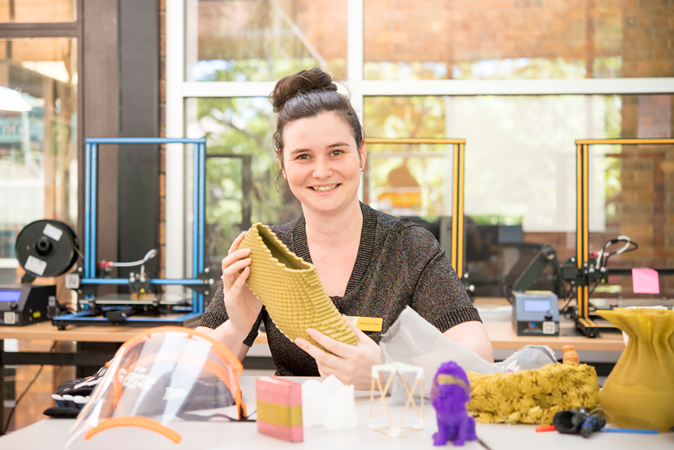
This paper presents the research design, process, and findings for an ongoing qualitative case study on users’ engagement in the University of Southern Queensland (UniSQ) Library Makerspace. The UniSQ Makerspace is a community space which provides equipment and expertise for hands-on projects and learning, fostering creativity and knowledge sharing. In this presentation I focus on how a visual research method has been incorporated into semi-structured interviews. This helped to further a participant-driven dialogue and contributed to how themes were developed through thematic analysis.
The case study explores how Makerspace users are engaging with the space and its services via three different usage modes: for course curriculum, extra-curricular, or research benefit. The visual and tactile nature of the Makerspace provided an opportunity to expand the scope of photo-voice research techniques to include other forms of visual media and add depth to interview responses. Interview participants were invited to share visual media (such as photos or the physical output of a Makerspace project) as part of the interview process. This presentation explores how this research approach helped to elicit rich perspectives and engagement from participants.
'Just Read' - A school based action research project
Ms Gabrielle Mace and Ms Merrilyn Lean
SESSION 2 – Lightning talks
Miss Reham Alsuhaibani (presenter), Drs Huan Vo-Tran, Elizabeth Tait & Naomi Whiteside
A library and lecturer collaboration: Evidence based practice and foundational research skills in undergraduate nursing students
Dr Erin Roga, Ms Karen Pruis and Dr Myles Strous
This lightning talk will describe a small case study currently being undertaken on the impact of a series of library classes on nursing students’ research skills in evidence-based practice.
Internal course evaluations showed a marked increase in students’ confidence with evidence-based practice research skills, leading to the continuation of the library classes this year, and expanding them to also include post-graduate nursing students. The team received ethics approval to formally survey the 2022 nursing students in the same course in order to report and share the success of the collaboration between nursing academics and librarians.
A recent review found that although information literacy was taught across a wide range of nursing programs, only a third of the articles reported librarian involvement (Cantwell et al., 2021). There is evidence that increased librarian involvement in courses leads to improved assessment quality (Booth et al., 2015; Shannon & Shannon, 2016). A more ongoing librarian role also allows for information literacy to be scaffolded over time, which has been shown to be an effective way of teaching evidence-based practice (Disler et al., 2019).
It also seems that although evidence-based practice closely aligns with information literacy, there is little acknowledging this in the literature (Cantwell et al., 2021), showing there is still a considerable need for collaboration between librarians and nursing faculty. This is most effective when seen as a partnership between the librarians and lecturers and can lead to improved information literacy and research skills understanding (Franzen & Sharkey, 2021).
References
Booth, C., Lowe, M. S., Tagge, N., & Stone, S. M. (2015). Degrees of impact: Analyzing the effects of progressive librarian course collaborations on student performance. College & Research Libraries, 76(5), 623-651.
Cantwell, L. P., McGowan, B. S., Planchon Wolf, J., Slebodnik, M., Conklin, J. L., McCarthy, S., & Raszewski, R. (2021). Building a bridge: A review of information literacy in nursing education. The Journal of nursing education, 60(8), 431-436. https://doi.org/10.3928/01484834-20210722-03
Disler, R. T., White, H., Franklin, N., Armari, E., & Jackson, D. (2019). Reframing evidence-based practice curricula to facilitate engagement in nursing students. Nurse Education in Practice, 41, Article 102650. https://doi.org/10.1016/j.nepr.2019.102650
Franzen, S. R., & Sharkey, J. (2021). Impact of embedded librarianship on undergraduate nursing students’ information skills. Journal of the Medical Library Association, 109(2), 311-316. https://doi.org/10.5195/jmla.2021.913
Shannon, A., & Shannon, V. (2016). Librarians in the midst: Improving student research through collaborative instruction. Journal of Political Science Education, 12(4), 457-470. https://doi.org/10.1080/15512169.2016.1157486
Art Online: transformations in digitisation and discoverability of University Art Museum collections
Mr Stephen V Graham
Many Australian universities have significant art collections located in museums on campus. Although these cultural institutions may be showcased on the university website, online access to the artworks themselves is quite often limited. My research investigates this assumption, identifying how much content is digitised and examining different ways one cohort of universities – the twenty-one member universities of University Art Museums Australia (UAMA) – enables the online visibility and discoverability of objects within their art collections.
The research investigates strategies deployed by universities to reveal the richness and diversity of their collections:
- How do university art museums harness the digital environment to display their collections and increase their discoverability?
- How do these cultural institutions extend and explore the creative and interpretive potential of their art collections online?
Dr Helen Cheung, Ms Yoko Hirose Nagao and Dr Mary Carroll
This presentation is to show a cooperative international education project. This project is being developed by HKSKH Ming Hua Theological (MH) College, a tertiary college in Hong Kong in association with Japanese partners (The Library Fair Management Committee & Rapidswide Company) and the Libraries Research Group of Charles Sturt University, Australia. Due to challenges of the pandemic, such as lockdowns, more library users now rely on digital libraries and digital literacy skills are more important. Also, libraries may face tight budgets and reduced staffing, and have to find a way to create innovative library models for pandemic/post pandemic times. The project aims to develop “outreach worldwide digital libraries” via online tours/talks with user education and library extension activities, as well as to make the importance of libraries and librarians more visible.
This project is based on the framework of evidence-based practice. The project was based on findings from a literature review, professional experiences and expertise of librarians/faculty/professionals, available resources, IT tools and international partnerships. Collaborative teaching and collaborative learning practices were developed. Librarians, faculty/teachers with students as well as business parties (e.g. experts in rare books) in Hong Kong, Japan and Australia took turns to conduct online tours/talks. Up to now, a total of five online tours/talks have been conducted in three languages (English, Chinese and Japanese) covering various topics such as library tours, rare books and library education for online audiences from Asia, Australia, North America and Europe. This lighting talk will use a MH college/ library tour of this project as a case study to explain 1: how we use evidence-based practice to develop the tours. 2: how collaborative teaching, collaborative learning, IT tools (Zoom, smartphone & AR/ VR etc) and international partnerships facilitate the project and 3: show what the overall outcomes of the project are.
SESSION 3
The education and training role of Australian academic librarians: A variety of conceptionsMs Romany Manuell
Academic librarians in university libraries perform a variety of roles. For many librarians, this includes a role in the education and training of university students, faculty staff and/or colleagues in areas related to research, libraries and information. This presentation will briefly explain the theory, method and preliminary findings of a doctoral research project nearing completion at Charles Sturt University. Using role theory as a framework to define the concept of role, and phenomenography as an underpinning approach and research methodology, in-depth interviews with 38 Australian academic librarians in the State of Victoria were undertaken in 2019 to explore librarians’ understandings of their educative role. Interview transcripts were analysed according to phenomenographic methods, allowing the emergence of a variety of conceptions. Data analysis led to four qualitatively different categories of description within the phenomenon of the academic librarians’ educative role. The educative role can be conceived of as falling within one or more of the following four spectra: an unexpected/expected role, a transactional/relational role, a role that operates as a site of completed/continuous learning and a role to be accepted/rejected as part of a librarian identity. The greater understanding of the variety of academic librarians’ conceptions of their educative role provides opportunities to influence curriculum for librarianship, inform recommendations for employers and prompt academic librarians to reflect on their role and practice, all of which may contribute to better learning outcomes for university library users.
Dr Bhuva Narayan
Wednesday, 5 October 2022
Users’ experiences in a regional university library makerspace
The UniSQ Makerspace is a community space used for creating and hands-on activities. It includes equipment for digital fabrication, electronics, and crafting (UniSQ Library Makerspace, n.d.). Responding to a gap in the literature on “makerspaces within Australian universities,” the University of Southern Queensland (UniSQ) Library’s Coordinator (Evidence Based Practice) and Coordinator (Community Engagement) undertook a practice-based research project, seeking local evidence to inform the UniSQ Library Makerspace (Wong & Partridge, 2016, p. 146).
Part of UniSQ Library’s commitment to evidence-based practice includes going beyond the analysis and interpretation of evidence to applying findings and communicating these. This means integrating evidence into our practice, improving the delivery of library services, and contributing to the wider LIS evidence base. Clare Thorpe (2021a, 2021b) has described the benefits of sharing work across a range of forums, reaching different audiences. While applying the findings from this case study may not be a linear process, the evidence collected helps to highlight the Makerspace’s value to its users, address barriers to participation, and support its increased visibility.
The case study design incorporated a visual method in the data collection phase and findings were developed through a reflective thematic analysis. The visual method was a variation of a photovoice technique. Including a visual element aligned with the very nature of the Makerspace itself, as the projects and technology in the Makerspace are very tactile, hands-on, and involve visual outputs. It provided a unique way for participants to share work that was meaningful to them and how they engaged in the space.
By having the choice to share projects, or to just describe them verbally, participants could choose when they wanted to centre their own projects in the conversation, and they could determine how much significance the physical object (or a visual representation of it) held to describing their own experiences.
Five themes were developed from the interview transcripts:
1. A Tentative Start
2. Practical Motivations
3. Skills Development
4. Community Connection
5. Influencing Outlook
Makerspace, this was alongside hesitancy and a lack of understanding of its purpose. For some students this presented as a feeling of “not being able to in there without … thinking that I'm intruding” (CC1). Without an understanding of purpose, there was uncertainty around who belonged and could utilise the space.
Formal introductions to the Makerspace, embedded in coursework, helped to highlight its practical and functional value, for both study and research. It was, then, after becoming involved, that the opportunities for skills development and community connection were realised.
Ongoing participation saw participants develop new perspectives, knowledge, and future pathways. These new outlooks grew from an understanding of how creativity, technology, and science could come together to help others. As one student described:
“I didn't expect this to now be such a big part of my life … nearly every day I'm thinking about what I can print, what I can design … how I can make something better … it's made a huge difference, and I didn't think it would” (CC2).
References
Thorpe, C. (2021a). Announcing and advocating: The missing step in the EBLIP model. Evidence Based Library and Information Practice, 16(4), 118–125. https://doi.org/10.18438/eblip30044
Thorpe, C. (2021b). Sharing and communicating – a necessary addition LIS evidence based practice model. https://lark-kollektive.blogspot.com/2021/12/sharing-and-communicating-necessary.html
UniSQ Library Makerspace. (n.d.). About. https://makerresources.usq.edu.au/index.php/314-2/
Wong, A., & Partridge, H. (2016). Making as learning: Makerspaces in universities. Australian Academic & Research Libraries, 47(3), 143-159. https://doi.org/10.1080/00048623.2016.1228163


.png)