Search This Blog

Saturday, 27 June 2015

EBLIP8


Suzana Sukovic
A whole conference devoted to applied research  – it’s a nerd dream come true to a LARK. I am looking forward to EBLIP8 so much that I allowed it to rule my weekends – a bit of work for the Program Committee, background reading, preparing a presentation and a workshop - and the first LARK meeting outside Sydney. Next weekend is a shopping-packing-flying routine and then three days of talking practice-based research. Imagine! If you have read so far, I think you can agree it isn’t just my weird taste to find it all so exciting.

EBLIP8 registrations are closing on Monday 29th. Only two days left to join all the fun! When you are filling in the registration form, please pay attention to many excellent workshops. Bhuva Narayan and I presenting the Workshop 3 From blog to academic article

LARK meeting is on Tuesday 8-9 am. As the meeting descriptions says, we will network and discuss how we can work together across geographical distances.


Thursday, 25 June 2015

LARK event tonight

Suzana Sukovic

The LARK event - tour of the UTS library retrieval system and workshop How to get published?, followed by dinner at a Japanese restaurant - are tonight. Everyone involved in organising this event is looking forward to an evening of stimulating conversations and good fun. 

Anyone who has made the last moment decision to come is welcome to join us. The workshop will start at 6.15 pm. See LARK post on 20 May for details.

People who are going to the LRS tour will be escorted to the workshop. Others who are coming straight to the workshop will be directed from the entrance at the UTS Library. Someone from the LARK group or library staff at the front desk will be there to let you pass the security gates. We'll be in the Lecture Room 4K.

We'll use #LARK @UTSLibrary on Twitter. Join the conversation!

Wednesday, 10 June 2015

Special guest at the LARK workshop on 25 June


By Suzana Sukovic
 
LARK is delighted to announce a special guest at the LARK workshop How to get published? Dr Joycel Kirk will join Dr Bhuva Narayan and me in answering your questions and planning the best publishing route for you. 

Dr Joyce Kirk has been involved in most aspects of research: preparing funding applications and winning grants, leading and managing individual and team-based research projects, writing and editing research papers and reports, assessing grant applications and reviewing research papers for publication. With her academic colleagues at UTS, she has developed courses in information behaviour and research methods.  She has supervised the projects of research degree candidates in LIS and education and has examined theses for universities in Australia, India and New Zealand. 

I have to add that I was one of the lucky candidates who had Joyce as her Doctoral Supervisor.

Please let us know if you intend to come to the workshop by emailing lark.kolektive(at)gmail.com

Workshop details are in the previous post

Wednesday, 20 May 2015

Workshop 'How to get published?'

&Tour of the UTS Library Retrieval System 

When: Thursday, 25 June 2015
Where: University of Technology, Sydney

For this outing, LARK has organised everything you need to be informed, intellectually stimulated and entertained. Sounds like a tourist brochure, but this is a pretty accurate description of our plan for the evening:

Tour of the UTS Library Retrieval System (LRS) for an informative warm-up when you will see this amazing automated system for book retrieval 
Workshop 'How to get published?' for some intellectual stimulation and your chance to ask questions about best ways to communicate your research
Dinner with lovely LARKs for your entertainment and networking. 

You can join us for all or some of these activities.


Workshop How to get published?

You have done some research – now what? There are many opportunities to communicate results of your research, regardless of its size and significance. A major study as well as a small-scale survey or literature review is likely to have an audience. In this workshop, you will consider blog, professional magazine, academic journal and a book as possible publishing outlets, each with its own advantages and requirements. Publication in a scholarly journal will be considered in some detail – the choice of a LIS journal, manuscript submission and peer-review process. You will have opportunities to ask questions, share experiences and network. The workshop is suitable for professionals and students.
The workshop will be presented by doctors Suzana Sukovic and Bhuva Narayan. See below for details about presenters.

Details


Tour of the UTS Library Retrieval System (LRS)

Meeting place:  Tower building (CB0.2) Level 4 in front of the concierge desk.
Start time: 5 pm
Cost: Free

Workshop How to get published?
PlaceUTS Library, CNR Quay St & Ultimo Rd, Haymarket 
Time: from 5.45 pm for 6.15 pm start till 7.45 pm. The LRS tour guide will escort the group to the library.  
Cost: Free

Dinner from 8 pm.

RSVP: 24 June lark.kollektive-at-gmail.com (please indicate activities)


Workshop presenters

Dr Suzana Sukovic has an extensive experience in the library and information sector. She has presented her professional and academic work in a range of publications, and experienced peer-review process as an author and a peer-reviewer. Suzana has learnt about communication of research by conducting her doctoral study into issues of knowledge production and by collaborating on research projects. Suzana is currently Head of the Learning Resource Centre at St. Vincent’s College, Potts Point in Sydney and Co-Chair of the ALIA Research Advisory Committee. She leads ALIA LARK and regularly contributes to the LARK blog. Transliteracy and the use of digital technology for learning and knowledge production are her main research interests.
Dr Bhuva Narayan is an academic in the School of Communication at the University of Technology, Sydney, and coordinates the Digital Information Management program. Her professional background is in the book and publishing industries.  She has an MLIS from the iSchool at the University of Pittsburgh and a PhD from the Queensland University of Technology, Australia where she studied Information Behaviours. Bhuva teaches in the area of Library and Information Science, ICT, and Social Media and her research interests are in human interactions with information and IT, human learning, and social media. Her current research projects include the use of mobile technologies to investigate information management for people with diabetes, developing a user-friendly technology to combat cyberbullying, and the use of social media in teaching.

Thursday, 14 May 2015

Leadership: nature or nurture?

By Diana Hodge

Displaying leader.jpg
With the focus on newly appointed ALIA leaders, I thought it might be interesting to highlight some research into leadership; I was interested in what skills leaders require and the question of whether leaders are born or can be trained. I found a very interesting series of articles by Pixey Anne Mosley. Published in the journal Library Leadership & Management under the column heading of ‘Engaging Leadership’ the articles explore what it means to lead and the myriad of ways in which an individual can show leadership qualities. For anyone aspiring to leadership but wondering if you are really the right ‘type’ of person or for those in leadership positions who suffer from ‘imposter syndrome’ Pixey’s articles are fascinating, thought provoking and hopefully will encourage you to view leadership differently. These articles are not research based; rather they are well informed observation and discussion; all available in full text through the ALIA subscription to ProQuest available to members here.

The first one of the series I read (2014 a) discussed the distinction between ‘grassroots leaders’ and those in ‘titled’ leadership roles. The former are those that ‘lead from the middle’; they may lead by example by getting things done, motivating others, by questioning decisions and standing up against group-think. All these behaviours are examples of leadership but they are frequently overlooked in favour of the titled managerial leadership model. In this model leadership is directly linked to particular organizational roles. Too strong a link between leadership and power or being ‘in charge’ is not a healthy thing for an organization.


It is incumbent on those of us already in leadership positions to look for these subtle indicators of leadership ability in those on the ground and understand that not all leadership roles are the same – they can require completely different skill sets. A great grass roots leader will be passionate about what they are doing at the micro level and may not be able to make the adjustment to seeing the big picture at a higher level. A more senior leader needs to be able to detach themselves from their own particular passions in order to make balanced, objective decisions. ‘Passionate’ is, I think, a much overused word, we are all meant to be passionate about our work and it was very refreshing to read a discussion around the value in being dispassionate.


This ability of leaders to disengage is the focus of another of Pixey’s pieces (2014 b). We tend to think of disengagement as a negative thing but for successful leadership it is an essential ability. Not only is it essential for decision making but can also be crucial in dealing with individual poor performance. Pixey addresses various scenarios in which the leader must emotionally disengage from a situation. When all avenues for improvement have been exhausted a leader may have to stand back and let a staff member fail; to disengage to the point where you watch another individual fail is hard to do. Most of us work in team based cultures and giving someone enough rope to hang themselves is not comfortable. I wish I had read Pixey’s discussion of this a few years ago before I was faced with exactly this situation.


The final column I will mention is Understanding and respecting the shades of gray (2013, nothing to do with 50 Shades!). For anyone who doubts themselves as a leader or for those making the transition to leadership it is quite relief to read this article – leadership doesn’t come with a rule book, decisions are not clear cut and those that we are attempting to lead can be ‘highly emotional, variable and unpredictable’ (p.5). I highly recommend Pixey’s articles for anyone who wants a realistic picture of the sometimes murky waters of leadership.


References
Mosley, P 2014 (a), Leadership writ large, beyond the title, vol. 28, no. 2, pp. 1-6
Mosley, P 2014 (b), Knowing when to disengage, vol. 28, no. 4, pp 1-5 


This  article was first published in InCite (April 2015).


Dr Diana Hodge is Manager, Academic Library Services at the University of South Australia and co-chair of the ALIA Research Advisory Committee

Sunday, 10 May 2015

On the Mothers’ and Other Mothers’ Day

http://pixabay.com/en/paper-flowers-arts-and-crafts-paper-655387/
By Suzana Sukovic
 
There is a direct line between this blog and a sunny Saturday morning many years ago in which I lie in a bed covered by crispy linen, in my favourite pyjamas, a little bell around my neck to mark Vrbica*, and a huge plaster around my itchy leg. My sister had gone with our great aunt to an entertainment park and a day of special treats as children do on Vrbica. In my memory of that morning, there is my smiling mum giving me a book as a special offering. The book is solid, but light, with yellowish pages, which emanate that odour of old, printed paper. On the light brown cover are engraved letters
Jane Eyre. My first adult book.

A life of a mind starts and grows through numerous ordinary moments -- cuddling with mum and a book on a rainy day, an unrefrained stream of consciousness delivered to a patient grandmother, picnic with an aunt when we investigated what lied under the rocks. Mothers and other mothers** in our young lives who used books to turn moments of disadvantage into joyous life-long memories, who answered our numerous questions, sang with us and told us stories ignited our love of learning well before we started school and nurtured our special interests throughout childhood. In hind sight, there is a straight line between them and our adult lives as librarians, teachers, academics, inventors, artists and, in all of that, researchers. Because, what is research but a form of learning?


To mothers and other mothers – all the women who nurture children and their curiosity – thank you. You are the mothers of LARKs.


*'Lazarus Saturday (Vrbica) falls on the Saturday before Palm Sunday, which is always the sixth Sunday of Great Lent. It is dedicated to the memory of the resurrection of Lazarus of Bethany and of Christ entering Jerusalem, where children waited to greet him. This is exclusively a holiday for children, who go to church that day and their parents buy them bells bound by ribbons in the colours of the Serbia flag and place them around their necks.'

**Rachel McLean told me how her large family celebrates Mothers' and Other Mothers' Day.

Tuesday, 21 April 2015

Hail or storm, the research we have always wanted, will be


Or, What happened in the LARK workshop Research you have always wanted, but never had


By Suzana Sukovic


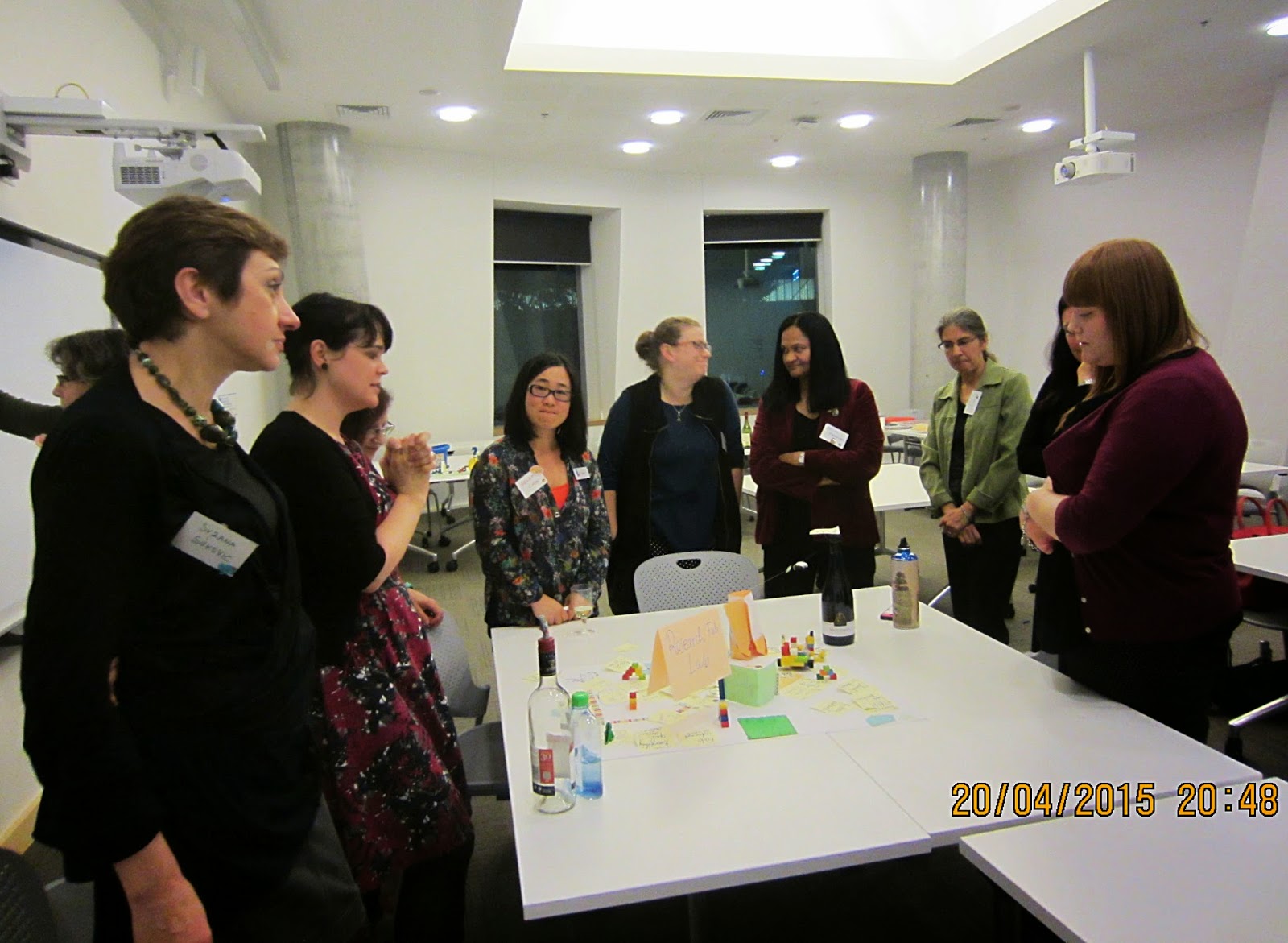
Torrential rain and gusty winds, described as the worst weather in Sydney in five years, didn’t prevent 13 committed people from gathering for a LARK workshop yesterday. The facade of the UTS Gehry building didn’t attract much attention on approach as we were struggling with wild umbrellas, but it all got better from the foyer. After a warm welcome by UTS own Bhuva Narayan and Edward Luca, a walk around the building and some refreshments, we were ready to think about research. As always, there were some familiar and new faces, and a good mix of library and information professionals of different sorts, academics and teachers.

Three capable team leaders, Helen Chan, Ashley England and Janet Chelliah, all from UTS Library, worked with me on workshop preparation but, at the last moment, we decided to have two groups. Janet graciously let her younger colleagues lead us through unpredictable waters of serious play. Helen and Ashley brought a copious amount of physical materials, including even a piece of fishing line to help us bring our grand ideas to surface.


I will abruptly stop here, curious reader. Our grand research plans will be revealed in due time, but we’ll need your co-operation first. Could you guess one or more of the following research-related questions?


What is the connection between elephant and research?


 What does the picture below represent? 


Why do we need a drone in the Research Fab Lab?  
(See the first picture above for clues)

Please use the comments field as your sandpit.


In the end, suffice to say, that our trip to the dinner destination was adventurous, taking a path littered by broken umbrellas. But, our efforts were well-rewarded.