Search This Blog

Thursday, 14 May 2015

Leadership: nature or nurture?

By Diana Hodge

Displaying leader.jpg
With the focus on newly appointed ALIA leaders, I thought it might be interesting to highlight some research into leadership; I was interested in what skills leaders require and the question of whether leaders are born or can be trained. I found a very interesting series of articles by Pixey Anne Mosley. Published in the journal Library Leadership & Management under the column heading of ‘Engaging Leadership’ the articles explore what it means to lead and the myriad of ways in which an individual can show leadership qualities. For anyone aspiring to leadership but wondering if you are really the right ‘type’ of person or for those in leadership positions who suffer from ‘imposter syndrome’ Pixey’s articles are fascinating, thought provoking and hopefully will encourage you to view leadership differently. These articles are not research based; rather they are well informed observation and discussion; all available in full text through the ALIA subscription to ProQuest available to members here.

The first one of the series I read (2014 a) discussed the distinction between ‘grassroots leaders’ and those in ‘titled’ leadership roles. The former are those that ‘lead from the middle’; they may lead by example by getting things done, motivating others, by questioning decisions and standing up against group-think. All these behaviours are examples of leadership but they are frequently overlooked in favour of the titled managerial leadership model. In this model leadership is directly linked to particular organizational roles. Too strong a link between leadership and power or being ‘in charge’ is not a healthy thing for an organization.


It is incumbent on those of us already in leadership positions to look for these subtle indicators of leadership ability in those on the ground and understand that not all leadership roles are the same – they can require completely different skill sets. A great grass roots leader will be passionate about what they are doing at the micro level and may not be able to make the adjustment to seeing the big picture at a higher level. A more senior leader needs to be able to detach themselves from their own particular passions in order to make balanced, objective decisions. ‘Passionate’ is, I think, a much overused word, we are all meant to be passionate about our work and it was very refreshing to read a discussion around the value in being dispassionate.


This ability of leaders to disengage is the focus of another of Pixey’s pieces (2014 b). We tend to think of disengagement as a negative thing but for successful leadership it is an essential ability. Not only is it essential for decision making but can also be crucial in dealing with individual poor performance. Pixey addresses various scenarios in which the leader must emotionally disengage from a situation. When all avenues for improvement have been exhausted a leader may have to stand back and let a staff member fail; to disengage to the point where you watch another individual fail is hard to do. Most of us work in team based cultures and giving someone enough rope to hang themselves is not comfortable. I wish I had read Pixey’s discussion of this a few years ago before I was faced with exactly this situation.


The final column I will mention is Understanding and respecting the shades of gray (2013, nothing to do with 50 Shades!). For anyone who doubts themselves as a leader or for those making the transition to leadership it is quite relief to read this article – leadership doesn’t come with a rule book, decisions are not clear cut and those that we are attempting to lead can be ‘highly emotional, variable and unpredictable’ (p.5). I highly recommend Pixey’s articles for anyone who wants a realistic picture of the sometimes murky waters of leadership.


References
Mosley, P 2014 (a), Leadership writ large, beyond the title, vol. 28, no. 2, pp. 1-6
Mosley, P 2014 (b), Knowing when to disengage, vol. 28, no. 4, pp 1-5 


This  article was first published in InCite (April 2015).


Dr Diana Hodge is Manager, Academic Library Services at the University of South Australia and co-chair of the ALIA Research Advisory Committee

Sunday, 10 May 2015

On the Mothers’ and Other Mothers’ Day

http://pixabay.com/en/paper-flowers-arts-and-crafts-paper-655387/
By Suzana Sukovic
 
There is a direct line between this blog and a sunny Saturday morning many years ago in which I lie in a bed covered by crispy linen, in my favourite pyjamas, a little bell around my neck to mark Vrbica*, and a huge plaster around my itchy leg. My sister had gone with our great aunt to an entertainment park and a day of special treats as children do on Vrbica. In my memory of that morning, there is my smiling mum giving me a book as a special offering. The book is solid, but light, with yellowish pages, which emanate that odour of old, printed paper. On the light brown cover are engraved letters
Jane Eyre. My first adult book.

A life of a mind starts and grows through numerous ordinary moments -- cuddling with mum and a book on a rainy day, an unrefrained stream of consciousness delivered to a patient grandmother, picnic with an aunt when we investigated what lied under the rocks. Mothers and other mothers** in our young lives who used books to turn moments of disadvantage into joyous life-long memories, who answered our numerous questions, sang with us and told us stories ignited our love of learning well before we started school and nurtured our special interests throughout childhood. In hind sight, there is a straight line between them and our adult lives as librarians, teachers, academics, inventors, artists and, in all of that, researchers. Because, what is research but a form of learning?


To mothers and other mothers – all the women who nurture children and their curiosity – thank you. You are the mothers of LARKs.


*'Lazarus Saturday (Vrbica) falls on the Saturday before Palm Sunday, which is always the sixth Sunday of Great Lent. It is dedicated to the memory of the resurrection of Lazarus of Bethany and of Christ entering Jerusalem, where children waited to greet him. This is exclusively a holiday for children, who go to church that day and their parents buy them bells bound by ribbons in the colours of the Serbia flag and place them around their necks.'

**Rachel McLean told me how her large family celebrates Mothers' and Other Mothers' Day.

Tuesday, 21 April 2015

Hail or storm, the research we have always wanted, will be


Or, What happened in the LARK workshop Research you have always wanted, but never had


By Suzana Sukovic


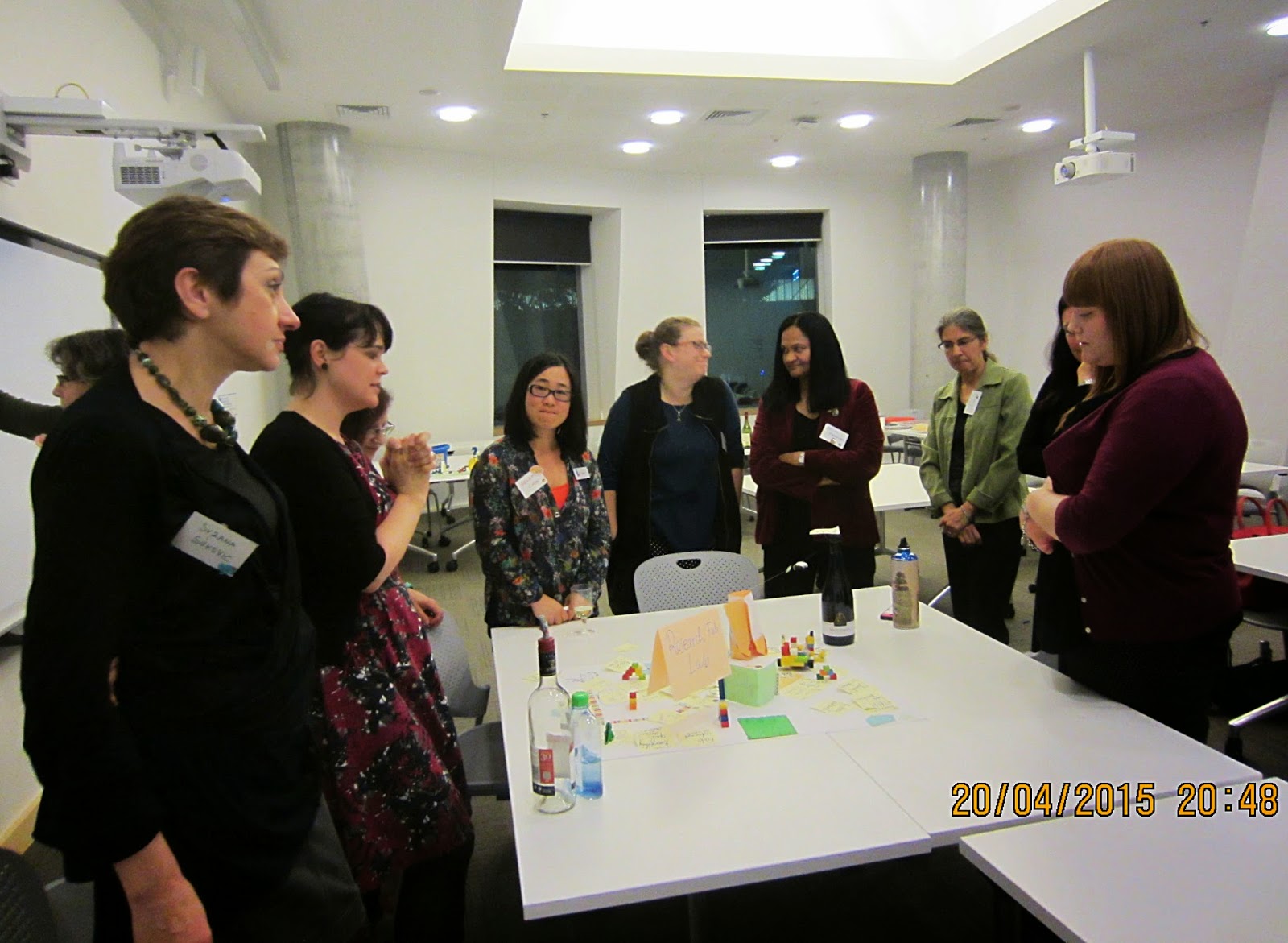
Torrential rain and gusty winds, described as the worst weather in Sydney in five years, didn’t prevent 13 committed people from gathering for a LARK workshop yesterday. The facade of the UTS Gehry building didn’t attract much attention on approach as we were struggling with wild umbrellas, but it all got better from the foyer. After a warm welcome by UTS own Bhuva Narayan and Edward Luca, a walk around the building and some refreshments, we were ready to think about research. As always, there were some familiar and new faces, and a good mix of library and information professionals of different sorts, academics and teachers.

Three capable team leaders, Helen Chan, Ashley England and Janet Chelliah, all from UTS Library, worked with me on workshop preparation but, at the last moment, we decided to have two groups. Janet graciously let her younger colleagues lead us through unpredictable waters of serious play. Helen and Ashley brought a copious amount of physical materials, including even a piece of fishing line to help us bring our grand ideas to surface.


I will abruptly stop here, curious reader. Our grand research plans will be revealed in due time, but we’ll need your co-operation first. Could you guess one or more of the following research-related questions?


What is the connection between elephant and research?


 What does the picture below represent? 


Why do we need a drone in the Research Fab Lab?  
(See the first picture above for clues)

Please use the comments field as your sandpit.


In the end, suffice to say, that our trip to the dinner destination was adventurous, taking a path littered by broken umbrellas. But, our efforts were well-rewarded. 


Wednesday, 25 March 2015

Research you have always wanted but never had

Suzana Sukovic

For this workshop, LARK will take you to a wonderful new creative space -- UTS Gehry building (the Dr. Cau Chak Wing Building). It will provide a unique setting for us to move away from our daily grind and think creatively about future realities. We will take a serious play approach to this workshop that will help us imagine models in which research is integrated with our profession, while getting to know each other better. After the fun hands-on workshop , we will continue conversations over dinner.

Attendees are free to come early and explore this distinctive building — the information desk is very friendly and some LARK members will be there at 5 pm to welcome and direct you. Many thanks to Bhuva Narayan for providing this opportunity!

When:
Monday 20/04/2015, 5.30 pm gathering for 6 pm start till 7.30 followed by dinner (optional)
RSVP 17 April
Where:
14 Ultimo Rd, Haymarket, University of Technology, Sydney
Room CB08.03.004 (UTS Building 8, Level 3, Room 004)
At the door: gold coin donation for ALIA members,
$5 for non-members


Everyone interested in LIS research is welcome. We take pride in being an open group. This is what people said about our meetings:
 · “welcoming and thoughtful”
· “People are interesting and interested”
· “I feel inspired to do something now”


Picture of the UTS Gehry building: 


Tuesday, 24 February 2015

LARK meeting @ EBLIP8


The Eighth International Evidence Based Library and Information Practice Conference
Suzana Sukovic

LARK @ EBLIP8

The EBLIP8 draft program is ready now with workshops galore. Check it out and start planning a wonderful mid-winter/mid-summer break in Brisbane! Three days talking about evidence-based practice – what else can a LARK wish for? A LARK meeting, perhaps. 


8 July at 8.30 am  If you are in Brisbane, here is the date and time for your diary. It is very exciting because this is the first time a LARK meeting is organised outside Sydney. As the meeting description says,  EBLIP8  is  a  unique  opportunity  for  people  outside  Sydney  to  extend  their  research  circle  by connecting  with  LARK.  This  meeting  will  be  an  opportunity  to  network  and  discuss how we  can  work  together  across  geographical distances. 

Birds of a feather flock together.


Picture above Rufous-naped_Lark_Bare_07_03_10_5.JPG

Monday, 16 February 2015

Quality assurance improvements in Australian university libraries


By Janine Schmidt

Karen Tang, Quality assurance improvements in Australian university libraries
Performance Measurement and Metrics vol. 14(1) 2013 pp.36-44

The need to reduce costs and maintain or extend services has led to an increasing focus on continuous improvement strategies within libraries. The libraries of the Australian Technology Network, LATN, comprising Curtin University, RMIT University, QUT, UTS, UNISA and the Auckland University of Technology have collaborated for some years on various projects. This paper describes the maturing of service improvements by the group from 2005 – 2010.

In 2005, a study reviewed quality assurance practices at the member libraries through examination of websites, a questionnaire and interviews. In 2010, the findings were revisited using the same questionnaire to determine further actions undertaken. This paper focuses in particular on the responsibility for quality assurance, the use of appropriate performance frameworks and the extent of involvement of individual training and work planning, to determine growth in line with a framework developed by Wilson and Town in the United Kingdom. This framework establishes five levels of quality assurance from an ad hoc approach at Level 1 to an advanced approach at Level 5, where all activity and the organisation culture are focused on continuous improvement.

What is quality assurance? It includes performance measurement, planning and benchmarking against others to ensure that services provided are “fit for purpose”. Who determines the quality? It is the customer. Notions of TQM, balanced scorecard, the Australian Business and Service Excellence guidelines,  ADRI (Approach, Deployment, Results, and Improvement) and LEAN (have expanded on the approach. The paper notes the changing emphasis on quality, referring to AUQA (Australian Universities Quality Agency), whose activities have since been transferred to TEQSA (Tertiary Education Quality Standards Agency). We aim to create a smarter future for Australia - by upholding standards for students.

The paper notes the growing sophistication of approaches to quality assurance within the libraries studied. All have a documented quality framework; most allocation responsibility for quality improvement to a specific staff member; and almost all provided training programs at the individual level and emphasised individual performance as part of organisational performance. Planning, performance measurement, client surveys, documentation, systematic reporting and analysis of findings and encouragement of best practice have all become part of the organisational conversation. Most libraries have undertaken continuous improvement strategies as part of their overall institutional framework.

Libraries continue to operate under significant pressures for accountability. The tertiary education changes mooted add to the importance of ensuring that library services meet client needs effectively and provide value for money. All libraries must operate within a quality assurance framework. Collaborative activity, an appropriate organisational culture, training of staff and an emphasis on performance measurement from the client perspective will assist libraries in ensuring they deliver services cost-effectively.  Libraries who wish to win awards and plaudits from their customers must manage their quality assurance processes effectively.


This article was first published in Incite, Jan/Feb 2015

Janine Schmidt, AM FALIA
Director, Mukurta Solutions

Friday, 13 February 2015

Learning to stand on your own two feet


This article was published in Incite, Jan/Feb 2015
By Alycia Bailey
In conversation with an older colleague, Alycia Bailey was informed she was no longer a new librarian, but a librarian toddler: still learning to walk on her own, but no longer likely to slump into a ‘death position’ if left unsupervised. Now, having completed her fifth year as a library professional, Alycia has found herself compelled to reflect on the things she learned over those short years, and to share some of her lessons learned with new librarians who are only just learning to walk.

Collect evidence


In the past two and a half years since I started at my current position, I have joined LARK (Library Applied Research Kollektive) and completed a master’s research project. In the process I’ve learned the value of data. Even if you’re not studying formally, you should always be collecting data. Not just circulation statistics and door counts, but qualitative data as well. Get patron feedback about programs, write stream of consciousness notes after events or get a colleague to observe your practice and give you feedback. No matter how well you’re doing, it can always get better. Reflect on what you’ve done and how it can be improved.

Make programs interesting for you


If you’ve got to run a program while smiling and engaged for at least an hour, then it may as well be something you enjoy. My thing has been gaming. I’ve used games to encourage students to engage in critical thinking, word play and story-telling. In my master’s project I also used video games to get students interested in coding, mathematics and science. My participants could see that I was excited to be there, with them, sharing something amazing. My enthusiasm has infected them with a love of learning and makes them come back for more.

Smarter planning makes better programs


Even for regular lunchtime club meetings, I have learned to always make a short, reusable session plan. Sometimes it’s nothing more than dot points and I usually don’t bring it with me to meetings, but I find that the act of writing out a plan cements in my mind the purpose of the program and keeps me on track. Writing plans also helps you to focus your energy on what really matters and means your participants get the most out of the experience.

Get a life


When I started as a librarian, I would work all the time. I’m talking twelve hour days, skipped lunch breaks, late nights, early mornings, planning programs on my days off and checking work emails in bed. I was unhappy, tired and my work was suffering. I still work late occasionally and sometimes I skip lunch, but life is a lot more balanced and I’m better at work for it.

Alycia Bailey is librarian at St.Vincent's College, Potts Point and LARK's Treasurer.