Search This Blog

Monday, 16 February 2015

Quality assurance improvements in Australian university libraries


By Janine Schmidt

Karen Tang, Quality assurance improvements in Australian university libraries
Performance Measurement and Metrics vol. 14(1) 2013 pp.36-44

The need to reduce costs and maintain or extend services has led to an increasing focus on continuous improvement strategies within libraries. The libraries of the Australian Technology Network, LATN, comprising Curtin University, RMIT University, QUT, UTS, UNISA and the Auckland University of Technology have collaborated for some years on various projects. This paper describes the maturing of service improvements by the group from 2005 – 2010.

In 2005, a study reviewed quality assurance practices at the member libraries through examination of websites, a questionnaire and interviews. In 2010, the findings were revisited using the same questionnaire to determine further actions undertaken. This paper focuses in particular on the responsibility for quality assurance, the use of appropriate performance frameworks and the extent of involvement of individual training and work planning, to determine growth in line with a framework developed by Wilson and Town in the United Kingdom. This framework establishes five levels of quality assurance from an ad hoc approach at Level 1 to an advanced approach at Level 5, where all activity and the organisation culture are focused on continuous improvement.

What is quality assurance? It includes performance measurement, planning and benchmarking against others to ensure that services provided are “fit for purpose”. Who determines the quality? It is the customer. Notions of TQM, balanced scorecard, the Australian Business and Service Excellence guidelines,  ADRI (Approach, Deployment, Results, and Improvement) and LEAN (have expanded on the approach. The paper notes the changing emphasis on quality, referring to AUQA (Australian Universities Quality Agency), whose activities have since been transferred to TEQSA (Tertiary Education Quality Standards Agency). We aim to create a smarter future for Australia - by upholding standards for students.

The paper notes the growing sophistication of approaches to quality assurance within the libraries studied. All have a documented quality framework; most allocation responsibility for quality improvement to a specific staff member; and almost all provided training programs at the individual level and emphasised individual performance as part of organisational performance. Planning, performance measurement, client surveys, documentation, systematic reporting and analysis of findings and encouragement of best practice have all become part of the organisational conversation. Most libraries have undertaken continuous improvement strategies as part of their overall institutional framework.

Libraries continue to operate under significant pressures for accountability. The tertiary education changes mooted add to the importance of ensuring that library services meet client needs effectively and provide value for money. All libraries must operate within a quality assurance framework. Collaborative activity, an appropriate organisational culture, training of staff and an emphasis on performance measurement from the client perspective will assist libraries in ensuring they deliver services cost-effectively.  Libraries who wish to win awards and plaudits from their customers must manage their quality assurance processes effectively.


This article was first published in Incite, Jan/Feb 2015

Janine Schmidt, AM FALIA
Director, Mukurta Solutions

Friday, 13 February 2015

Learning to stand on your own two feet


This article was published in Incite, Jan/Feb 2015
By Alycia Bailey
In conversation with an older colleague, Alycia Bailey was informed she was no longer a new librarian, but a librarian toddler: still learning to walk on her own, but no longer likely to slump into a ‘death position’ if left unsupervised. Now, having completed her fifth year as a library professional, Alycia has found herself compelled to reflect on the things she learned over those short years, and to share some of her lessons learned with new librarians who are only just learning to walk.

Collect evidence


In the past two and a half years since I started at my current position, I have joined LARK (Library Applied Research Kollektive) and completed a master’s research project. In the process I’ve learned the value of data. Even if you’re not studying formally, you should always be collecting data. Not just circulation statistics and door counts, but qualitative data as well. Get patron feedback about programs, write stream of consciousness notes after events or get a colleague to observe your practice and give you feedback. No matter how well you’re doing, it can always get better. Reflect on what you’ve done and how it can be improved.

Make programs interesting for you


If you’ve got to run a program while smiling and engaged for at least an hour, then it may as well be something you enjoy. My thing has been gaming. I’ve used games to encourage students to engage in critical thinking, word play and story-telling. In my master’s project I also used video games to get students interested in coding, mathematics and science. My participants could see that I was excited to be there, with them, sharing something amazing. My enthusiasm has infected them with a love of learning and makes them come back for more.

Smarter planning makes better programs


Even for regular lunchtime club meetings, I have learned to always make a short, reusable session plan. Sometimes it’s nothing more than dot points and I usually don’t bring it with me to meetings, but I find that the act of writing out a plan cements in my mind the purpose of the program and keeps me on track. Writing plans also helps you to focus your energy on what really matters and means your participants get the most out of the experience.

Get a life


When I started as a librarian, I would work all the time. I’m talking twelve hour days, skipped lunch breaks, late nights, early mornings, planning programs on my days off and checking work emails in bed. I was unhappy, tired and my work was suffering. I still work late occasionally and sometimes I skip lunch, but life is a lot more balanced and I’m better at work for it.

Alycia Bailey is librarian at St.Vincent's College, Potts Point and LARK's Treasurer.

Wednesday, 10 December 2014

INKE Sydney gathering


Research Foundations for Understanding Books and Reading in the Digital Age: E-merging Reading, Writing, and Research Practices
An INKE-hosted Birds-of-a-Feather Gathering
8 December 2014, State Library of New South Wales

By Suzana Sukovic


A Birds-of-a-Father Gathering hosted by the Canadian group INKE (Implementing New Knowledge Environments) turned out to be a beginning of the festive season for me. Really. This seminar was a summer rain for my brain parched by the heat of end-term rush, administrative duties and noise of building works. It had all the elements of great gatherings – good organisation, nice people with fresh ideas, thoughtful insights and shared interests, lots of time for discussion and pleasant surroundings.

The organisation of the gathering required a great deal of preparation to create time for discussions during the day. After a selection of abstracts, authors were asked to write long papers, which were collated into a nearly 300 page long document and shared with participants. During the seminar, each paper was allocated 10 minutes – strictly 4 minutes for a presentation and the remainder for questions and discussions. Keynote addresses had a more generous time allocation, still with ample time for discussions. In this blog post, I will share some of the ideas presented during the day, keenly aware that a brief overview can’t do justice to the richness of arguments and conversations.


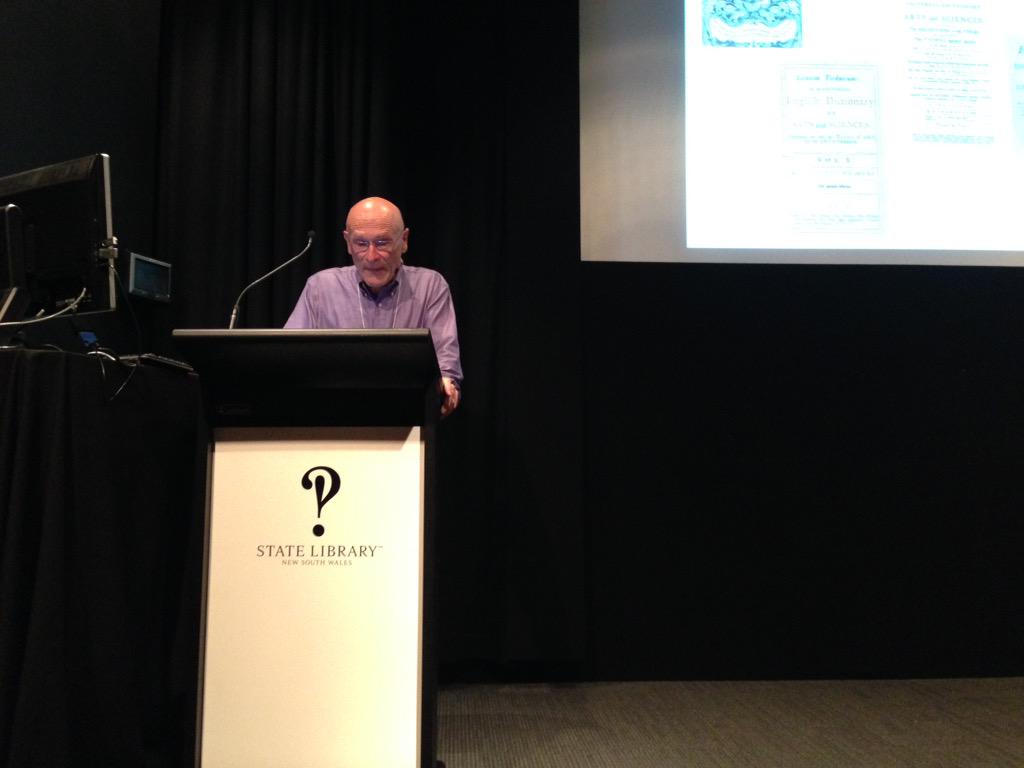
Embedded image permalink
The first keynote speaker was Christian Vandendorpe (University of Ottawa) with the paper Wikipedia and the Ecosystem of Knowledge in which he shared his insights into the inner workings and reception of the encyclopedia. Vandendorpe presented a model of Wikipedia as a glasshouse in which everything is visible. He explained rigorous editorial process and invited scholars to contribute by writing articles and to consider its use in research. Teachers at all levels are encouraged to use Wikipedia’s educational spaces in class. An interesting question from the audience was whether the creation of a ‘world brain’ could lead to the homogenisation of knowledge and a loss of diversity.


Reading Technologies, Digital Production, & the Social was the title of the first session. John Maxwell (Simon Fraser U) argued that the WWW is the publishing paradigm of our time. He promoted the possibility of hacking scholarly work by adding value to it (for example, adding index to a publicly available work). Tully Barnett (Flinders U) discussed young people's social reading enabled by the Kindle social highlighting feature. Transliterate reading was my paper in which I considered how scholars, community members and teenagers search, read and create in a transliterate manner. I will present my 4 minute argument on the LARK blog shortly.


Session 2: Collaboration: Tools, Platforms, & Examples was marked by discussions about engagement with users and readers. Jon Bath (U Saskatchewan) presented a multi-authored paper describing an experiment to employ a plug-in for the Zotero bibliographic management system in collaborative projects. The users’ reluctance to try the software during the experiment prompted us all to reflect on the values of sharing negative research experiences. On behalf of his group, Bill Bowen (U Toronto) discussed his experiences with the Iter community, pointing out that ‘build it and they will come’ often doesn't work. Ellen Forsyth talked about the efforts of an international group of librarians to engage readers in online discussions on blog and Twitter. Ray Siemens (U Victoria; INKE) presented his team’s work on setting up an environment for collaboration in consultation with scholars in the humanities. He pointed out a quiet, but fast shift towards collaborative digital tools and behaviours, and need for an inclusive environment for an academic and ‘citizen scholar’.  Daniel Powell (King’s College London) and Lynne Siemens (U Victoria, INKE) discussed approaches to collaboration from a historical and organisational perspective. Powell argued that culture and knowledge production have always been collaborative while Siemens shared her experiences with establishing conditions for collaboration and emphasised the importance of establishing a common understanding among collaborators before the  project commences.

Jennifer Roberts Smith (U Waterloo) opened Session 3: Analysis & Experimentation challenging the audience to think about power and ‘book as the monument’ as a context for experimentation. Stan Ruecker ((Illinois Institute of Technology, INKE) described his team’s thinking about the development of several interfaces for the same programming background while Jon Saklofske (U Acadia, INKE) considered modularity and narrativity in the development of New Radial. Claire Timpany (U Waikaito) presented results of her doctoral research into users’ perceptions of visual markers of headings online. Images of strong men and infatuated women illustrated Jack Elliott’s (U Newcastle) talk about analysis of romance as a genre.


Session 4: Multimodal Knowledge Environments & Communities included a stimulating discussion about a range of topics. Jason Ensor (U Western Sydney) presented his and Belinda Barnet’s (Swinburne U of Technology) paper on experiments with post-print, bi-directional linking based on Ted Nelson’s Project Xanadu. They used Barnet’s work to showcase Nelson’s approach to establishing textual connections. The next two papers addressed issues of representing Indigenous Australian culture. Michael Walsh (Australian Institute of Aboriginal and Torres Strait Islander Studies) discussed challenges of cultural transfer when Aboriginal stories and songs are presented for a Western audience. It was interesting to hear that contemporary Indigenous musicians use Walsh’s old tape recordings as a basis of composition on synthesisers. Hart Cohen and Rachel Morley (U Western Sydney) presented their work on linking archival records and media to relevant passages of Strehlow’s book Journey to Horseshoe Bend. Finally, Brent Nelson (INKE) discussed museum as a knowledge environment and the implications for digital presentations.

The closing keynote address From Storythinking to Storymaking: Reimagining Narrative in the Academy by Sydney Shep (Victoria U of Wellington) invited the audience to consider the line between creative and analytical in the academy. Her reading of tweets from the #INKESydney14 was a masterful display of weaving analytical and performative in an academic discourse.

Conversations continued later in the evening over dinner with frequent references to analogue rain and a digital flow across the globe. Thanks, INKE, for freshly watered ideas.


See Twitter feed https://storify.com/suzanasukovic/inkesydney14.html OR https://storify.com/suzanasukovic/inkesydney14.pdf 

Saturday, 29 November 2014

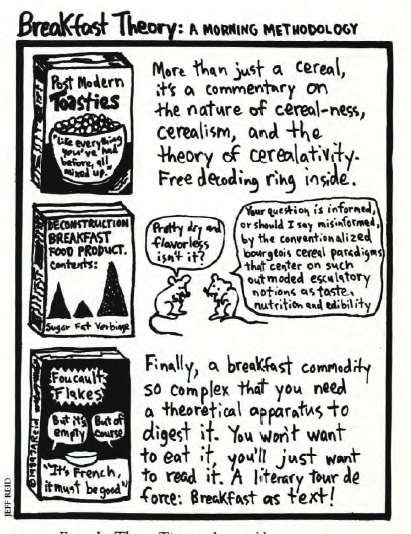
What’s the Point of Theory?

By Michael Olsson

https://www.flickr.com/photos/askpang/3269557195/sizes/o/
It’s fair to say that this is a question I’ve heard more than once in my career, sometimes from a student gazing in dismay at a reading list which includes Castells, Dervin and the occasional dead Frenchmen – but also on occasion, in from the occasional senior member of the profession disgruntled that my students don’t spend their every waking hour learning the Dewey Decimal System. While those asking this question usually intend it to be rhetorical, I thought I’d spend this column answering it.

Let’s start by clearing up one of the more common misconceptions: the world is not divided between airy fairy academic theorists and sensible people with common sense. Whether we’re aware of it or not, the kind of information professional we are is a product of our conceptual framework. The way we view our job, the way we interact with our clients, the decisions we make are the product of our existing beliefs, understandings and preconceptions. This personal worldview for all of us is invariably limited and contradictory so by engaging with different theories we open up the possibility of looking at the world in different ways, we can gain insights that transcend our personal experience. Systems and services are also built on assumptions, many of them so long standing that we’ve stopped noticing them.  Theory provides us with alternative lenses through which to evaluate their effectiveness.

Let’s consider, for example, one of the most common assumptions in information practice. Whether we’re looking at Dublin Core or Dewey, almost all classification schemes are still based on the 19th century documentalist idea that the role of the cataloguer is to ‘capture’ the intrinsic meaning in the text. Theory can gives the tools not only to see the flaws in this assumption but also the ways in which it can lead to systems that discriminate against, even actively exclude many information users.

The work of many theorists in the second half of the 20th century, from Roland Barthes to Brenda Dervin have pointed out that meaning isn’t intrinsic to documents, nor is it determined by authors, rather it is constructed by readers. Nor, as Michel Foucault or Birger Hjorland, would point out, do we make sense of texts in a random or ad hoc way. We are each of us connected, via language, education and experience, to our own particular social context – which is how we all know without thinking about it that we should interpret Miss Moppet in a different way from On the Origin of Species or Goldfinger! Once we take these theories on-board, we can start to conceive of our professional practice in a different way: one focussed on an understanding of the conceptual framework of the individuals and communities we engage with.

So can I suggest that the next time you’re considering a spot of professional development, that the most useful thing you could do, the one that might ultimately have the greatest influence on the kind of information professional you become, might just be to spend some time with the work of a dead Frenchman or two?       

First published in Incite, October 2014


Dr Michael Olsson - Graduate Coordinator, Information & Knowledge Management,University of Technology, Sydney


Friday, 24 October 2014

Staying in a transliterate flow

By Suzana Sukovic


Findings of the digital storytelling project iTell have been recently reported in the Australian Academic and Research Libraries (ALIA) under the title 'iTell: transliteracy and digital storytelling'. Workshops have been offered for three years in a row, research findings have been reported and action research cycles have been closed for now. But, iTell data has been talking to me ever since. One of the ideas that make me wonder and speculate is a possible connection between transliteracy and student engagement, a possibility of transliterate learning.


Audience with the Cupcake Queen by Nyari Morales
But, firstly, a bit of a background. iTell was offered at St.Vincent’s College, Potts Point, an independent high school for girls in Sydney, as a series of workshops in which students created digital stories based on stories they knew and liked. They looked into fiction of their choice from different perspectives, presented some oral stories for digital media or created their own digital stories. An important aspect of the project was the development of transliteracy skills through the process of creating digital stories. (Transliteracy relates to the ability to apply a range of skills in many different contexts while communicating and interacting with different media and technologies.) A research aspect of the project considered the development of transliteracy skills, student engagement with learning and any impact on learning after participation in the workshops. 


At the time when I decided to include engagement as a research question, I thought I was, most likely, setting myself for a failure. Why would students engage with iTell differently than with any other learning at school? Is there anything new in observing more of the same behaviour? Curiosity almost killed the cat but, in the end, student engagement, turned to be a particularly successful part of iTell. Some of the students in iTell workshops were gifted high-achievers, others were self-selected because of their interest in creative work, but many others were encouraged or even required to attend. A number of iTell participants were notoriously disengaged learners for whom iTell was an opportunity to try a different approach to learning. Their literacy levels covered a broad spectrum from struggling to highly literate students. Regardless of all the differences in skill and motivation, they all found something in iTell that kept their attention. In interviews, students reflected on how iTell was different from their classroom experiences. The difference was to do with the length of half- or whole-day workshops, which created opportunities for engagement; relaxed rules around how they were sitting and using space; the playful nature of some activities and the way they were set up to create opportunities for individual work and peer-support. The lack of assessment and any formal requirements had potential to become an issue when student self-motivation didn’t go far enough to sustain many hours of work. It may have been the case with few students but, for the majority, the absence of assessment created opportunities for a more organic integration of reflection and evaluation through the ‘story circle’, watching each other’s stories, providing informal feedback, public screening and reflection in research interviews. 


Student survey response (4 is maximum)

A context for transliteracy is an important aspect of student engagement, I suspect. ‘Transliteracy is about fluidity of movement across the field -- between a range of contexts, modalities, technologies and genres’ (Sukovic 2014). While mastering a range of specific skills is important, it seems that a transliterate way of working brings another quality. I speculate that a context for transliteracy encourages creativity and a sense of internal and external connections. Through these ongoing and evolving connections of skills and meanings, engagement is maintained and deepened. It seems that the fluidity of transliterate way of working supports ‘staying in the flow’ as defined by Csikszentmihalyi. Context for transliterate learning allows moving between a range of tasks, ideas and technologies providing mechanisms to maintain interest and the right level of challenge. Particularly important are different access points to learning. For example, writing a digital story can be approached as traditional story writing, visual story board, dramatic improvisation or developing a framework to work with technology, opening different approaches to the writing task.   


The idea of transliteracy came from the field of media and communication studies, but it has captured the interest of library and information professionals who are well positioned to take the idea of transliteracy further and, hopefully, provide some evidence for inklings and speculations about the nature of transliteracy. Working ‘across’ disciplines, technologies and practices is modus operandi for most librarians. More focused on the information needs of the person or group at hand rather than on any external requirements, librarians are in a position to think of new ways of applying their tool set to individualised transliterate contexts. 


Sukovic, Suzana. 2014. iTell: Transliteracy and Digital Storytelling. Australian Academic & Research Libraries 45 (3):205-229. 

iTell stories are available here

Dr Suzana Sukovic is the Head of the Learning Resource Centre at St.Vincent's College, Potts Point and Co-Chair of the ALIA Research Advisory Committee

Wednesday, 8 October 2014

Getting collaboration right

By Jennifer Berryman

This artice was first published in InCite (September 2014)

http://farm3.static.flickr.com/2535/3935972530_553dfe7349_m.jpg
Writing is the theme of this LIS Investigations column – at first glance, not a natural partner with the issue theme of collaboration, as writing is seen by many as a solitary endeavour.  But of course, writing and libraries are natural partners, as indeed are research and writing. This three-way relationship is the focus of Ferer’s investigation into collaborations between academic libraries and writing centres. 
Ferer’s research aim was to identify the range of activities embraced by libraries and writing centres when working together, to identify best practice.  Both these academic services are established to support students and help them succeed in a scholarly environment, and not surprisingly have a history of collaboration. The methodological approach was a review of the research literature published in English between 1999 and 2012. Ferer cautions that the results are somewhat skewed, as much of the literature reviewed is published by librarians rather than writing centre staff; the literature is overwhelmingly American.

A summary of the results of the review is grouped around five themes: outreach and partnership; building relationships; sharing space; providing services in each other’s space; jointly designing teaching modules and workshops. Interestingly, librarians providing services within the writing centre was one initiative for which results were mixed, although one library at least reported their services in the writing centre were well received as they were able to catch students seeking assistance at the very beginning of their research activity. 


The brief discussion focuses on the most frequently embraced collaborative activities rather than identifying best practice.  More popular collaborative activities included librarians providing writing centre tutors with training in library instructional services, for example, on how to manage citations, to enable them to assist students with their research. Other activities highlighted were co-teaching, cross-promotion of services and sharing spaces. Perhaps the most important finding discussed by Ferer is the importance of starting with small scale joint activities, and allowing the larger, more embracing activities such as combining services in a one-stop shop to emerge as the relationship develops.  While many of these activities are already in place in Australian university libraries, Ferer’s findings serve as a handy checklist when considering collaborative activity as a strategy to address the ongoing need to do more with less in delivering library services. 


Writing collaborations are also the focus of the work by Campbell, et al. The stimulus for their interest in forming a collaborative writing group in an academic library was the difficulty encountered in carving out time from busy days to write up research for publication. 


The authors analysed their own experiences against the published research of what is, they noted, an under-researched  field. The result is a list of factors likely to foster successful collaborative writing activities such as selecting compatible colleagues with whom to collaborate, and practical tips to increase the chances of being accepted for conference presentation or publication.  Also valuable is the brief consideration of the pitfalls that may be encountered. 


So to all those practising librarians who are keen to share the knowledge they have gained from in-house research activities  - have a look at this handy checklist , seek out writing partners with whom to collaborate and tell us about what you’ve found.


References

Ferer, E. (2012) Working together: library and writing centre collaboration. Reference Services Review, (40)4, 543-557
Campbell, K,. Ellis, M & Adebonojo, L.(2012) Developing a writing group for librarians: the benefits of successful collaboration. Library Management, (33)1/2, 14-21.


Image:
http://farm3.static.flickr.com/2535/3935972530_553dfe7349_m.jpg


Dr Jennifer M Berryman works at the State Library of New South Wales.